#12 | History of Cosmos - 1: Inception to Stargate
· 7 min read
“Cosmos itself is not a blockchain. It is a network of blockchains that are built to be compatible with each other.”
History of Cosmos - 1: Inception to Stargate Launch
Cosmos has made significant strides since its inception and has evolved into a robust platform for building and connecting blockchains. It all began with the release of the Cosmos Whitepaper in 2016, which paved the way for the continuous development of the Cosmos-SDK, the establishment of the Interchain Foundation (ICF), and ultimately the pivotal Stargate upgrade in 2021. Throughout this progression, Cosmos has continued to push the boundaries of what's possible in the blockchain ecosystem.
In this article, we will explore Cosmos Network's development journey, delving into the revolutionary ideas introduced in the 2016 whitepaper, the roles of zones and the Cosmos Hub, the birth of the Inter-Blockchain Communication (IBC) protocol, and the advancements brought by the ICF and Stargate upgrade. As we walk through this path, we will gain a deeper understanding of how Cosmos is shaping the future of the blockchain landscape.
Tendermint and the ABCI
Rewinding to 2014, when the blockchain ecosystem was still in its infancy, Jae Kwon and his team released the Tendermint whitepaper. At that time, many existing blockchain platforms faced significant scalability and interoperability challenges. Tendermint's consensus protocol offered a novel approach to address these issues.
Kwon aimed to design a consensus algorithm that was not only more efficient, scalable, and secure than existing systems, but also flexible enough to support various use cases. The Tendermint protocol achieves this by employing a Proof-of-Stake (PoS) system for block validation, which reduces energy consumption and is more efficient than traditional Proof-of-Work (PoW) systems used by other blockchain networks.
Tendermint Core
Central to Tendermint is Tendermint Core, a powerful consensus engine that can be used with any application modeled as a finite state machine.
Understanding Finite State Machines
A finite state machine (FSM) is a mathematical model of computations representing a system's behavior through a finite number of states, transitions, and actions. Each state signifies a specific condition or stage of the system, with certain inputs events triggering transitions.
In blockchain applications, a finite state machine represents the logic that defines how the system evolves over time. For instance, in a cryptocurrency application, states can represent account balances and transitions can represent transactions between accounts.
Tendermint Core is the consensus engine responsible for managing the blockchain's state and ensuring that all nodes in the network agree on the same state. It achieves this by using a Byzantine Fault Tolerant (BFT) consensus algorithm, allowing for faster block confirmation times and improved transaction throughput.
Application Blockchain Interface (ABCI)
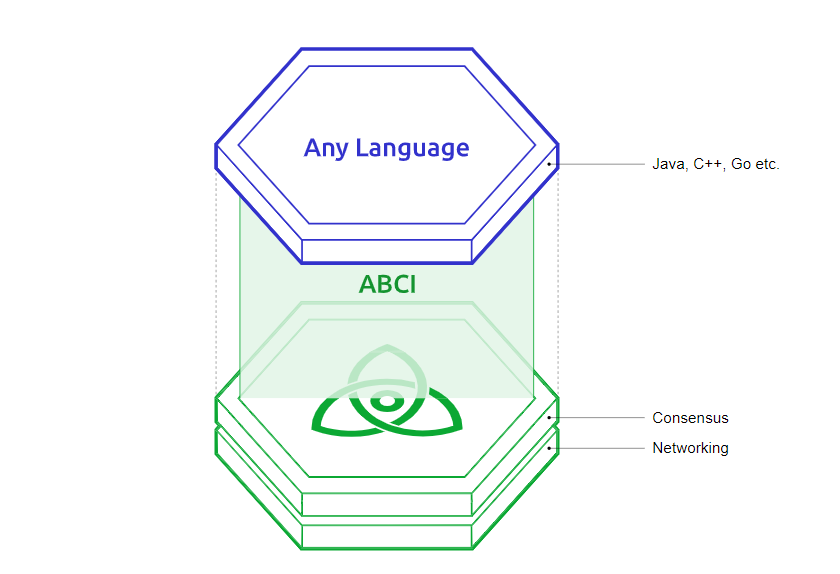
One key feature of Tendermint Core is its compatibility with any application that can be modeled as a finite state machine. This is accomplished by separating the consensus and application layers using the Application Blockchain Interface (ABCI).
The ABCI is a protocol that allows Tendermint Core to communicate with any application built on top of it, regardless of the programming language used. Once the application logic is in place, the ABCI facilitates communication between the application and Tendermint Core. This enables Tendermint Core to manage the consensus process and update the application's state accordingly.
This modular architecture empowers developers to build and optimize their application logic independently of the consensus mechanism, making it easier to scale applications and adapt them to the specific needs of large-scale projects.
Key Features of Tendermint Core
- Byzantine Fault Tolerance: Tendermint employs a Byzantine Fault Tolerance (BFT) consensus protocol, specifically the Practical Byzantine Fault Tolerance (PBFT) approach. This ensures all nodes in the network agree on the order of transactions in the blockchain, even when up to one-third of the nodes are Byzantine (i.e., malicious or faulty). The PBFT approach uses a two-phase commit process to achieve consensus, where nodes first propose a block and then validate it through a series of voting rounds. This process ensures all nodes in the network agree on the order of transactions and prevents malicious nodes from compromising the network's integrity.
- Instant Finality: Once a block is proposed and validated by validators, it is immediately committed to the blockchain and considered final. Users can be confident their transactions are finalized as soon as a block is created, without the need for multiple confirmations or waiting periods (unlike blockchains such as Bitcoin and Ethereum).
Tendermint has since become a key player in the blockchain space and has been adopted by numerous leading blockchain projects and platforms.
2016 | Cosmos Whitepaper: A Network of Distributed Ledgers
Since the release of the Cosmos whitepaper in 2016, the project has gone through various development stages, transforming how we build, operate, and connect blockchains. This phase, known as Initiation, gave birth to much of the Cosmos philosophy, technology stack, the Cosmos Hub, and the Inter-Blockchain Communication (IBC) protocol. This section discusses some of the major contributions spawned from the whitepaper.
Zones: Independent Blockchains Powered by Tendermint Core
Cosmos introduced the concept of "zones," which are independent blockchains powered by Tendermint Core. Each zone can be designated as the "source" for one or more token types, granting it the authority to manage the token supply. This innovative idea enabled multiple blockchains to coexist and interact within the Cosmos ecosystem.
A Network of Independent Parallel Blockchains
The whitepaper also proposed a specification for an "Internet of Blockchains." This concept was based on the Tendermint consensus engine, the ABCI application interface, and the InterBlockchain Communication (IBC) protocol — a TCP-like protocol for reliable communication between untrusting blockchain networks.
The cryptocurrency community warmly welcomed the Cosmos whitepaper, and Tendermint's adoption grew as a flexible and mature platform for building blockchain applications. By the end of summer 2016, initial funding to develop Cosmos was secured, setting the stage for a revolutionary era in the blockchain ecosystem.
Birth of IBC
The Inter-Blockchain Communication (IBC) protocol was first proposed as a core feature of the Cosmos Network in the original whitepaper released in 2016. It was designed to enable independent blockchains to communicate with each other in a trustless and decentralized manner, allowing not only for the seamless exchange of value but for the creation of more complex applications that span multiple blockchains.
IBC is a protocol that allows the transfer of arbitrary data, in the form of "packets," across independent and heterogeneous blockchain networks. Its primary function is to enable the exchange of tokens and information between blockchains, allowing users users to perform cross-chain transactions across. This continues to open up new opportunities for decentralized finance (DeFi) and other blockchain applications while promoting interoperability and fostering a more connected blockchain ecosystem.
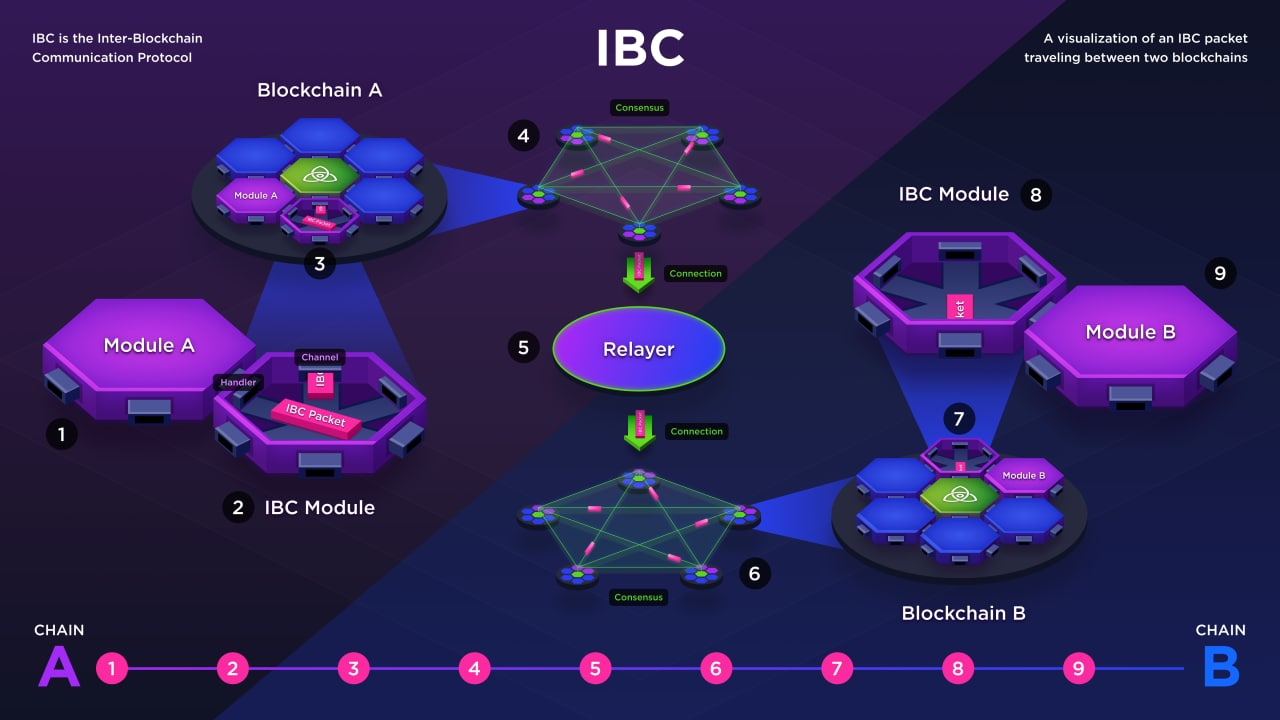
One significant benefit of IBC is its ability to distribute workloads across multiple blockchains, reducing network congestion and improving scalability. The enhanced scalability, combined with the unique features and capabilities of different blockchains, opens up opportunities for developers to create innovative cross-chain applications and services.
IBC requires both the sender and receiver blockchains to commit to the packet in several steps, ensuring consensus among all parties involved and preserving the transaction's integrity. Additionally, the protocol utilizes Merkle-proofs, cryptographic proofs that ensure the authenticity and integrity of data within a Merkle tree, to guarantee secure data transfers. This process maintains the required trust while ensuring secure transmission of information.
The Interchain Foundation (ICF)
Established in March 2017, the Interchain Foundation (ICF) is a Swiss non-profit organization founded by builders and visionaries such as Zaki Manian, Jae Kwon, and Ethan Buchman. The ICF focuses on promoting the growth of open-source projects related to distributed ledger technologies, particularly the Cosmos Network — a decentralized network of independent parallel blockchains.
Since then, the foundation has invested in research, development, and education initiatives concerning blockchain technology, interoperability, and the Cosmos ecosystem. It also supports the development of key Cosmos Network components, including the Tendermint Core consensus engine, the IBC protocol, and the Cosmos SDK.
More on this can be found at the ICF blog.
Growth of the Cosmos-SDK
After its initial inception in 2016, the Cosmos-SDK continued to evolve and expand with many capabilities being added over the years. The community reached a big milestone with the release of SDK v0.34.
Cosmos SDK v0.34
Version 34 included performance optimizations in areas like memory usage, block processing, and transaction throughput. The CLI and RESTful API became more user freindly, and security features were added to improve the key management system, encryption schemes, and general resilience of the SDK to threats and attacks.
Cosmos SDK v0.40
-
Protocol Buffer migration:
Cosmos SDK v0.40 replaced the previous encoding library, Amino, with Protocol Buffers (also known as protobuf). This migration enhanced serialization, deserialization, and overall performance. Protocol Buffers also provided better language support and simplified client development.
-
Modular architecture improvements:
This version further refined the modular architecture of the SDK, making it easier for developers to build and customize their blockchain applications. By simplifying the process of adding or modifying modules, the Cosmos SDK became more accessible and versatile for developers.
-
Upgradability:
The v0.40 release also focused on streamlining the upgrade process for the SDK and the applications built on it. This ensured a smoother transition when new features or improvements were introduced, minimizing disruptions to the existing ecosystem.
Cosmos Hub (Gaia): The Heart of the Network
In March 2019, the Cosmos Hub, or Gaia, became the first zone in the network. The Cosmos Hub uses the ATOM token as its native currency and enables users to stake their tokens to earn rewards and vote on governance proposals. These proposals can automatically modify system parameters, like the block gas limit, coordinate upgrades, or alter the Cosmos Hub's policies.
While the Cosmos Hub acts as a central point for managing interchain connections, it does not verify or execute transactions committed on other zones. Each zone can have its own sovereignty and governance. The Cosmos Hub helps ensure the the overall ecosystem's stability.
The implementation for IBC was released this year
Early Chains that Emerged
- Osmosis: A blockchain network powering the main interchain decentralized exchange with incentivized liquidity provision that highlighted many of the cross-chain capabilities in the Cosmos. Osmosis enables cross-ecosystem cryptocurrency trading, super-fluid staking, and yield farming in a user-friendly UI.
- Akash Network: A decentralized cloud computing marketplace enabling users to rent out their unused computing resources as an open-source, cost-effective alternative to traditional providers.
- Terra: The first chain that leaned heavily into supporting CosmWasm smart contracts. Terra was at once a thriving blockchain platform for programmable stablecoins and general-purpose dApps. It experienced incredible success in both user adoption and in bootstrapping a third-party development ecosystem, but Terra eventually suffered economic collapse when the UST stablecoin de-pegged, taking down its sister coin, LUNA.
- ThorChain and ThorSwap: A decentralized liquidity network enabling cross-chain swaps between cryptocurrencies without centralized exchanges, promoting greater liquidity.
- Kava: A DeFi platform allowing users to borrow, lend, and earn on digital assets through services like stablecoins, decentralized exchanges, and money markets.
- Binance Chain (BNB Chain): A high-performance blockchain platform developed by Binance for creating new assets and exchanging existing ones while supporting DeFi applications. Note that Binance Chain and Binance Smart Chain (BSC) are two separate platforms.
These networks are just a few examples of the projects that emerged following the launch of the Cosmos Hub. They illustrate the diverse range of applications and use cases made possible by the Cosmos SDK and Tendermint Core.
Stargate
With a strong foundation in place, Cosmos was ready to take the next big step in its development journey. In 2021, the Cosmos ecosystem underwent a significant upgrade known as "Stargate." This upgrade, led by Iqlusion, introduced numerous improvements and new features, further enhancing the capabilities of the Cosmos Network and setting the stage for its future evolution.
Stargate | Key Features
The Stargate upgrade introduced the implementation of several features, including the IBC protocol for interoperability, Protocol Buffers (Protobuf) migration for improved performance, State Sync for faster node synchronization, and the Chain Upgrade Module for more efficient upgrades. These features played a critical role in advancing Cosmos' vision of creating an "Internet of Blockchains" and optimizing the overall developer and user experience.
- IBC Protocol: The Stargate upgrade introduced the IBC protocol, enabling interoperability between different blockchains within the Cosmos ecosystem. IBC facilitates the transfer of tokens and data across various sovereign blockchains, allowing them to communicate with each other while maintaining their security and independence. This feature was a critical step towards Cosmos' vision of creating an "Internet of Blockchains.”
- Protocol Buffers (Protobuf) Migration: The upgrade involved a migration from Amino encoding to proto as the standard serialization format. This migration significantly improved the performance and developer experience on the Cosmos network. Protobuf allows for faster serialization, smaller payloads, and cross-language compatibility, enabling better performance and broader client support.
- State Sync: State Sync was introduced in the Stargate upgrade, allowing new nodes to quickly join the network by syncing the blockchain state from other nodes without having to download and process the entire transaction history. This feature reduces the time required for a new node to become operational and participate in the network.
Post-Stargate Era
The Stargate upgrade marked a significant milestone in the Cosmos ecosystem's development, laying a solid foundation for future growth. In the post-Stargate era, Cosmos is poised to expand its impact on the blockchain landscape and embrace political and economic challenges and opportunities.
So far, we’ve provided an overview on some of the highlights in Cosmos’ journey from its early beginnings up to 2021. As we conclude Part 1, we invite you to stay tuned for future articles exploring recent and ongoing developments in the interchain ecosystem.
References
- Jae Kwon, Ethan Buchman. 2016. Cosmos Whitepaper: A Network of Distributed Ledgers
- Ethan Buchman. Sep, 2022. Phases of Cosmos
- What is Tendermint? - Tendermint Core Docs
- Cosmos/Stargate-Launch - GitHub Repository
- Gavin Birch. June, 2020. Cosmos Stargate Upgrade Overview
- IBC-Go Docs
🔮 Docs | 👾 Discord | 🐦 Twitter | 🔥 Web App
⛓️ ️Explorer | 🌴 Link Tree | 👨💻 Code