#27 | Who’s Who: Navigating the Titans of the DeFi Perps Players
· 4 min read
Historical context: This post describes early Sai work as of 2023-11-06. Product details and launch plans reflect that period. See the Sai documentation for current trading and integration guides.
An intro to perps, on-chain vs off-chain derivatives, and spotlights on major players including the upcoming dApp, Sai.
Introducing “Perps” as an Instrument
Perpetual-swaps (perps) are blockchain-based derivatives with no expiration date, and represent one of the most promising frontiers in decentralized finance (DeFi).
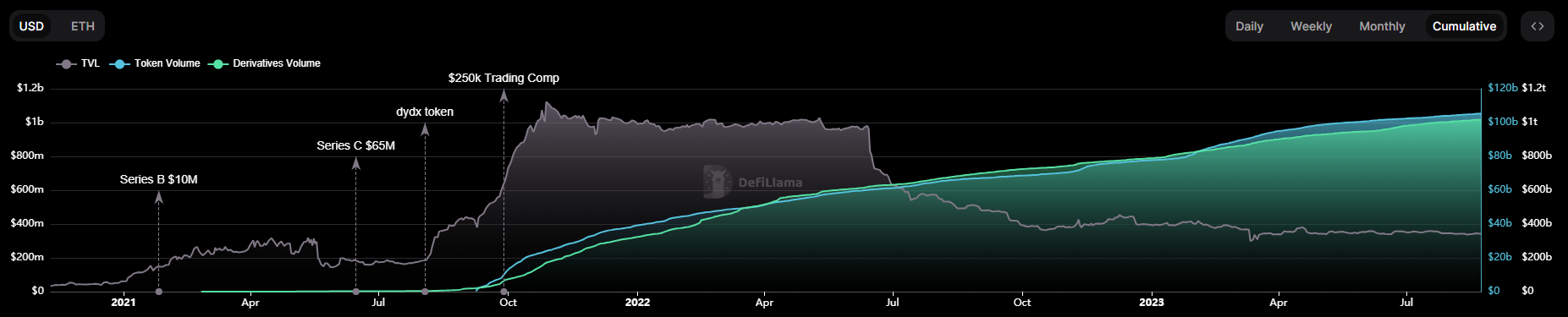
For context, dYdX, a leading on-chain derivatives exchange, reported a total volume of $466 billion and fees of $138M in 2022. Since its v3 launch on StarkEx in Feb 2021, dYdX has seen over $1T in cumulative derivatives trading volume, capturing a dominant industry market share. Meanwhile, DEX cumulative spot trading volume stood at $2.8T from Feb 2021 to Aug 2023, even though it debuted in 2016.
While on-chain derivative volumes lag behind spot volumes, centralized exchange derivatives outpace on-chain, with DeFi exchanges accounting for only about 5% of total volumes. This discrepancy signals a significant growth opportunity for DeFi perps.
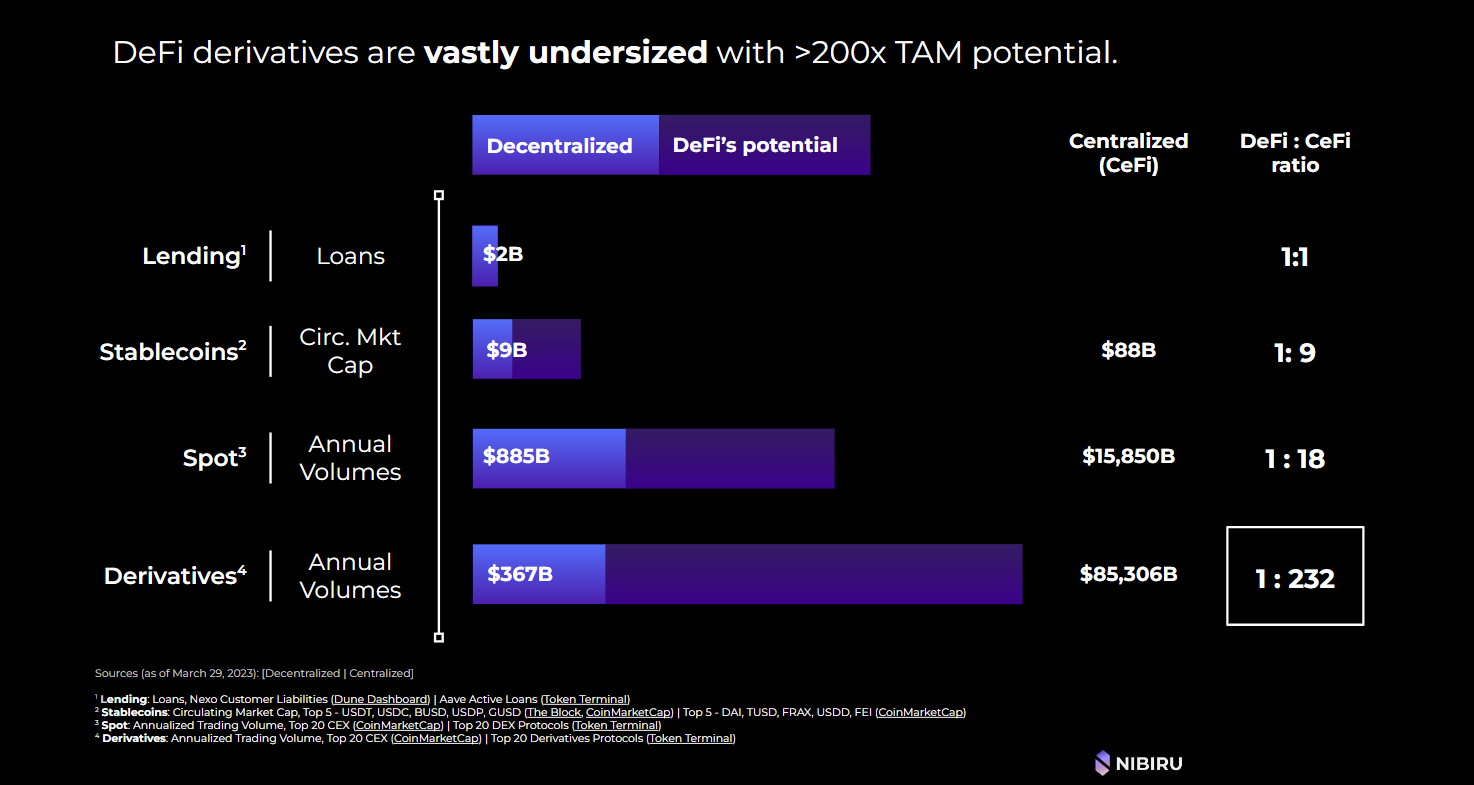
On-chain derivatives are relatively new, with roughly three years in operation. In contrast, commodity-based derivatives have historical roots going back to 1849.
This article will explore the pros and cons of on-chain derivatives, introduce perpetual swaps, and highlight six pivotal projects in this domain. Future pieces by Nibiru will dive deeper into specific topics and provide a thorough reviews of peers.
At a glance, this piece will dive into the following broad points:
- On-chain derivatives benefit from transparency and composability, but come at the expense of speed.
- Perpetual-swaps are a form of derivative with no expiry date that enable hedging, leveraged trading, and shorting. They are highly liquid and increasingly arriving on-chain.
- Notable perpetual projects include GMX, Perpetual Protocol, Drift Protocol, Injective (Helix), dYdX, and Nibiru
- Each project has unique features. For instance, GMX boasts no slippage and solid tokenomics but offers fewer available assets.
- We can anticipate more innovation in this area and a rise in traders from traditional finance exploring these protocols
Derivatives: On-Chain vs. Off-Chain
Derivatives are financial instruments or contracts that derive their value from underlying assets or benchmarks. They have been increasingly moving on-chain where they can be traded via DeFi networks such as Ethereum and Cosmos, and in turn benefit from blockchain technology.
One major reason for this shift is transparency. In traditional finance, “B-Books” enable brokerages to take the counterparty position in a given trade rather than immediately executing it to a third-party liquidity provider. Such practices have raised concerns about market manipulation and front-running since the brokerage, acting like the dealer, can see all players' moves. On-chain derivatives inherently offer transparency, fostering a more level playing field in the market.
On-chain derivatives also thrive on composability, seamlessly integrating like “money legos” with other DeFi products. As they share a common blockchain infrastructure with other DeFi protocols, they can interact directly without intermediaries. This interoperability allows them to merge with tools like decentralized lending protocols, giving rise to innovative offerings such as loans backed by derivative contracts.
A significant drawback of decentralized networks is speed. While traditional finance, being centralized, operates swiftly, decentralized systems require consensus, introducing latency. Even if finality times are under a second, they still fall behind centralized finance, a difference that becomes pronounced during volatile periods.
The primary distinction between on-chain and off-chain is speed versus decentralization.
Given the advancements the technology offers, it's logical to foresee more derivatives moving to on-chain platforms. That being said, user experience and regulatory challenges could impede this shift.
Perps: A Quick Primer
Perps are on-chain derivatives like futures but without an expiration. Users can speculate on an asset's price without owning it. The perp's price is the mark (or strike) price, such as a BTC perp's price, while the price it follows is the index price, like BTC's average across exchanges.
In an perfect liquid market, the mark price and index price should align for market efficiency and accurate liquidations. This balance prevents issues like long/short skew, especially in perp-AMMs discussed in the Perpetual Protocol section. If there's a price mismatch in the mark and index price due to volatility or low liquidity, one side pays the other an interest called the "funding rate" to restore balance to bring prices back to equilibrium.
For instance, if a trader is long on a $29,000 BTC perp contract, but BTC trades at $28,000, the long trader is at a loss. They owe interest to the shorts, encouraging them to close their position to realign the BTC-perp price closer to $28,000. The longer this discrepancy lasts, the more the long trader loses.”
Why are perps useful? Beyond being highly liquid, they serve three main functions:
- Hedging: If worried about BTC's price falling, take a short position using Bitcoin Perps.
- Leverage: Amplify positions using leverage. With 10x leverage, a 10% price shift means a 100% gain/loss.
- Short Exposure: Take short positions without borrowing the asset.
We will dive deeper into perps later. For now, know that traders use them for leveraged trades, hedging, and speculation, all without an expiration date.
Spotlight #1: GMX
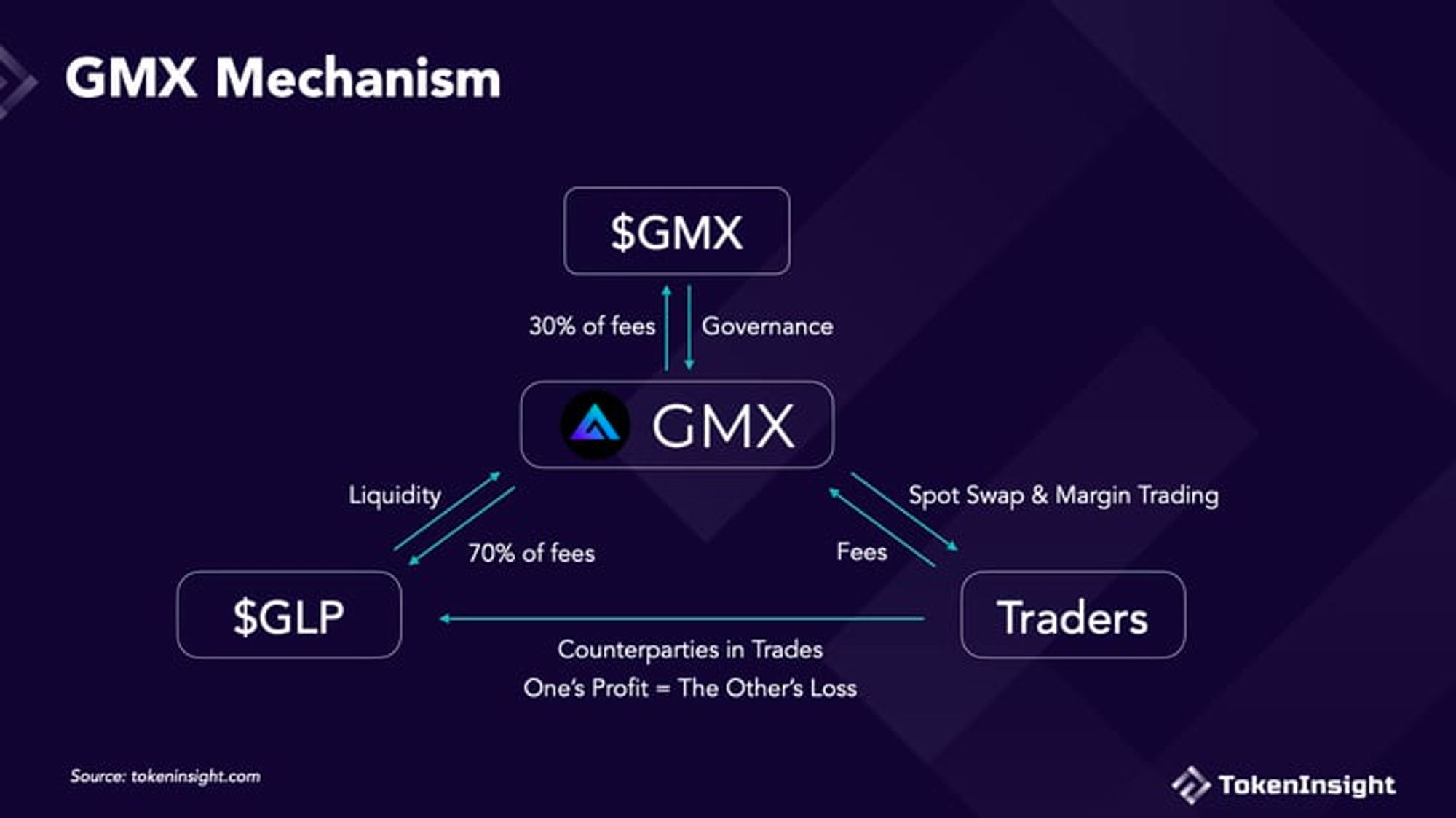
GMX is a popular perps-swap and spot trading platform, originating on the Arbitrum network and later expanding to Avalanche. Since its late 2021 launch, it's attracted over 270,000 users, in part due to its zero-slippage pricing - a draw for larger investors. This is possible thanks to the "GLP" liquidity pool which acts as a trade counterparty. Owning the GLP token signifies a share in this pool, while the GMX token serves for utility and governance.
Despite the overall 76% drop in DeFi's TVL from $205B to ~$50B between 2022 and Aug 2023, GMX's TVL soared from $246M to ~$900M, making it Arbitrum's leading protocol.
GMX boasts impressive stats:
- Volume: ~$200M daily | >$140B cumulative
- Fees: ~$320K daily | >$225M cumulative
- Distinct Users: >300K (all-time)
GMX has $500M in GLP assets under management as of Aug, 2023. The GLP accrues value by:
a) Accumulating trader net losses, as it acts as the counterparty. b) Receiving 70% of trading fees, with the remaining 30% going to the GMX token.
One of the standout features of the GMX platform is its zero-slippage model, made possible by the GLP serving as a counterparty. Unlike many other DeFi platforms where slippage can accumulate over time, GMX offers significant savings, especially beneficial for heavy traders with large positions.
Furthermore, GMX has a clear-cut value accrual system: 30% of trading fees benefit GMX stakers, encouraging long-term commitment, while 70% goes to the GLP, ensuring consistent liquidity. The average losses experienced by traders further contribute to the GLP's value. This system not only enriches the value of GLP and GMX tokens but also bolsters network liquidity and promotes long-term token retention.
A limitation of the GLP token is that it supports only five non-stablecoin assets: ETH, BTC, UNI, LINK, and AVAX. This choice is deliberate, as incorporating more assets into the GLP could introduce systemic risks due to the necessity of meticulously managing GLP liquidity and token ratios.
Spotlight #2: Perpetual Protocol
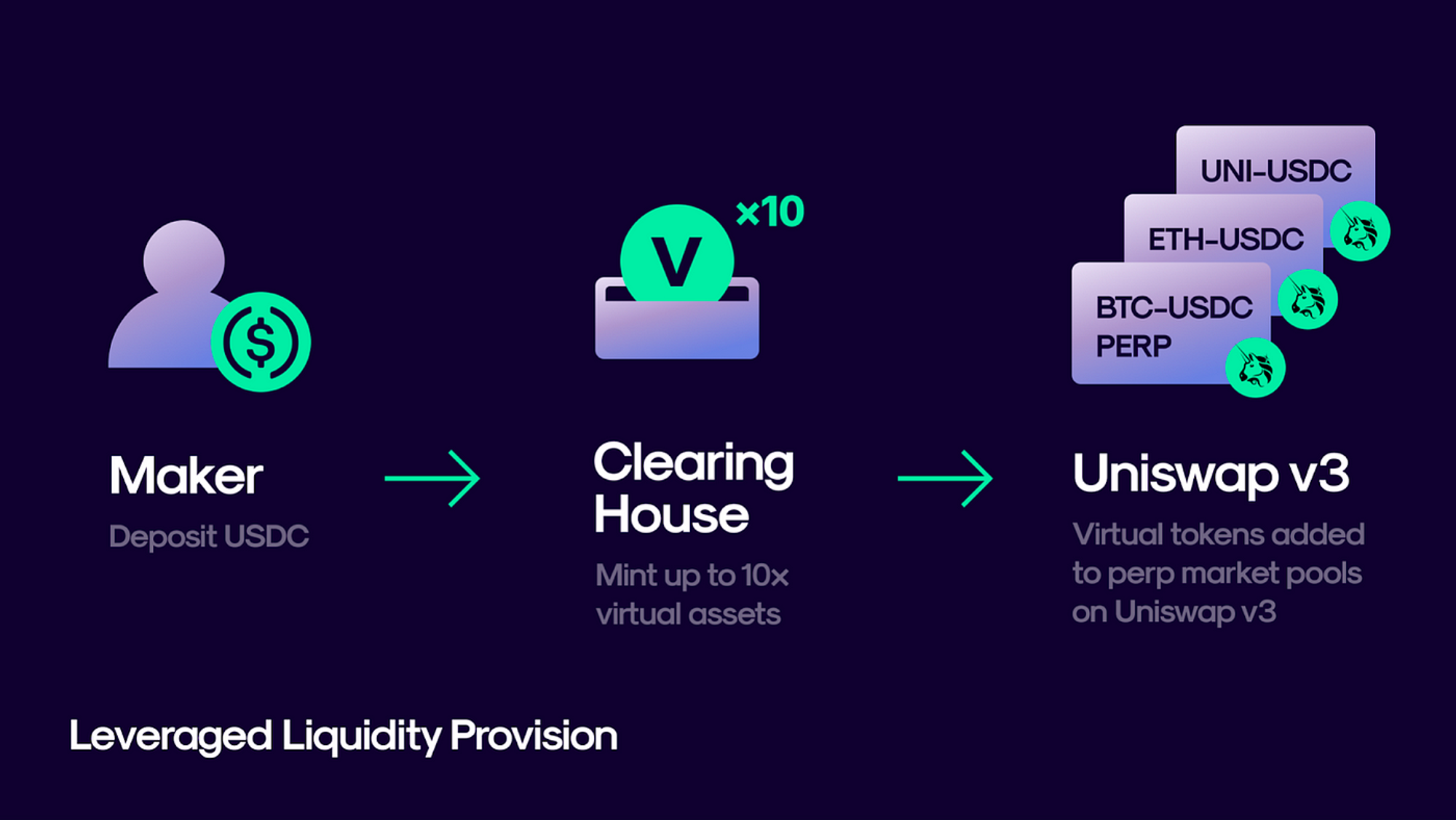
Perpetual Protocol V1, introduced on the xDAI network in December 2020, innovated with its virtual AMM (vAMM) concept, which simulates AMM pricing without the need for an actual asset pool. While this concept was theoretically sound, provided short and long positions remained balanced, challenges arose during the prolonged bull run of early 2021. As the ETH (index price) surged, the perps price (mark price) on Perpetual lagged. With the mark price falling below the index price, shorts had to pay interest to longs, prompting more long positions. The insurance fund of Perpetual, intended as a safety net, was strained to cover these payments, proving unsustainable. Consequently, V1 was retired.
In late 2022, Perpetual Protocol V2 was launched on Optimism, with positions secured by actual USDC and features such as concentrated liquidity. V2 addressed long/short liquidity imbalances. The protocol also introduced vote-escrowed token economics, a model akin to what's seen in platforms like Curve Finance. By locking PERP tokens for a year, holders receive vePERP tokens. These tokens grant a share of fees and allow holders to allocate future PERP token distributions to specific vaults. The receipt of fee rewards hinges on the insurance fund exceeding a set threshold and is determined by the individual's share of vePERP tokens.
According to Dune Analytics, V2 stats include:
- Volume: ~$30M daily trading, $18B cumulative
- Fees Collected: $17M
- Distinct Users: ~350K
Surprisingly, even with a trading volume significantly lower than GMX, Perpetual Protocol boasts 340K unique traders compared to GMX's 240K. The reasons behind this disparity remain unclear and might be tied to differences in internal reporting standards.
Perpetual Protocol pioneered several key features: they were the first to introduce perps, they developed the vAMM model, and they led the way in adding a liquidity provisioning function, enabling "makers" to supply liquidity within defined ranges.
Spotlight #3: Drift Protocol
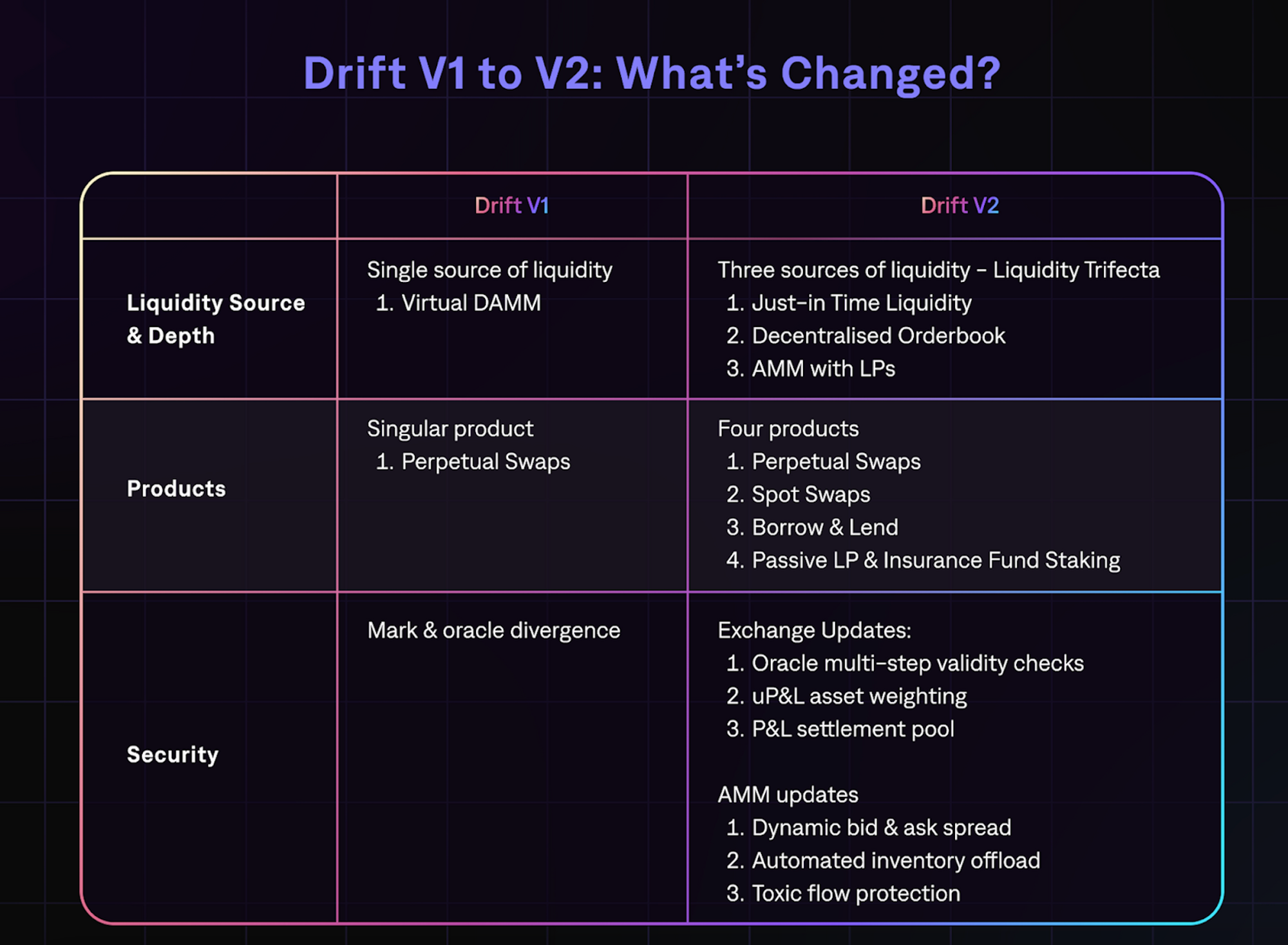
Drift Protocol, a derivatives exchange on Solana, draws inspiration from Perpetual Protocol and introduces a variant of the vAMM model termed dynamic AMM (dAMM). In addition to their dAMM, they incorporate an order book feature, allowing users to establish limit trades. This not only addresses long/short imbalances but also enhances market liquidity. Drift Protocol provides perps with up to 10x leverage and features lending/borrowing with fluctuating interest rates, staking, and spot token swapping.
Drift’s statistics are as follows:
- Total Trades: >4.0M
- Volume: ~$870M cumulative
- Distinct Users: ~6,500
Despite having fewer unique users, Drift Protocol's limited active time frame plays a role. Drift V1 ceased operations in May 2020 after the Luna/Terra collapse, and its December 2022 relaunch came on the heels of the FTX collapse. Its existence has largely been during a bear market. However, its users have been notably active, with an average trading volume of just over $130K per user.
Drift utilizes a just-in-time (JIT) model to optimize liquidity and ensure superior order execution. This approach has maintained the platform's stability, enabling larger trades with minimal slippage. Additionally, their dAMM design has rectified the long/short imbalances experienced in Perpetual Protocol V1.
Spotlight #4: Injective (Helix) & dYdX
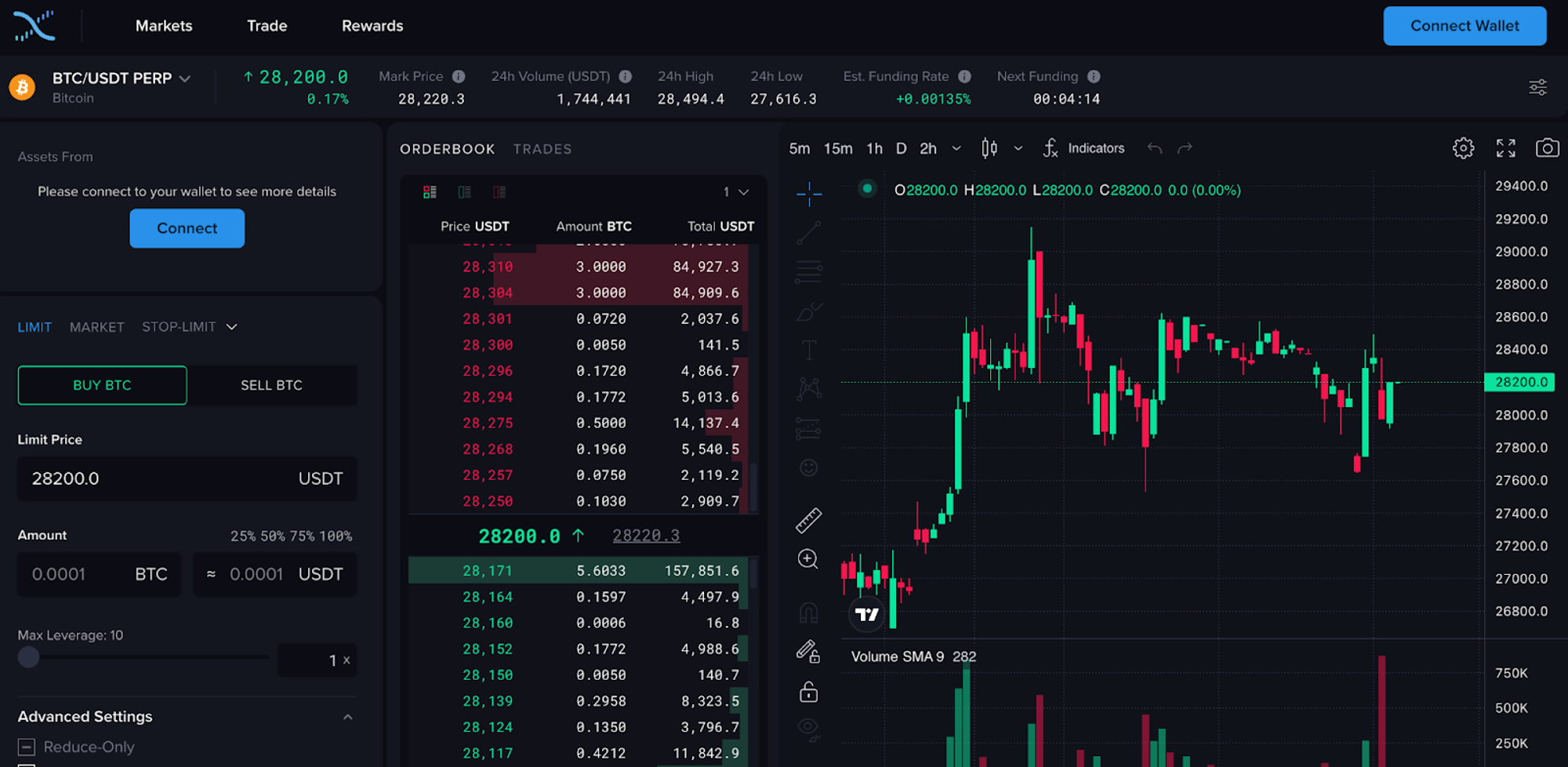
Injective, built on the Cosmos platform, facilitates access to, creation of, and trading in DeFi markets, encompassing order book perps. Capable of handling up to 25,000 transactions per second, the primary perps-swap developed on their framework is termed Helix. By managing their order book and matching engine on-chain, Injective positions itself as one of the more decentralized entities.
dYdX, another order book-centric perpetuals exchange, who’s v3 operates on Ethereum through StarkEx and uses AWS for off-chain trade matching. However, in June 2022, they announced a transition to Cosmos for their v4, aiming for a full launch by September 2023.
Thus far, dYdX has processed:
Injective/Helix currently lacks public trading data.
Both Injective and dYdX are compatible with market makers who prefer order book-based derivatives exchanges. Each market significant increases in throughput: Injective with a fully on-chain method and dYdX with a hybrid off-chain one. Injective created their own Injective Bridge, which bridges liquidity and connects to Ethereum's vast community.
Main spotlight: early Sai development
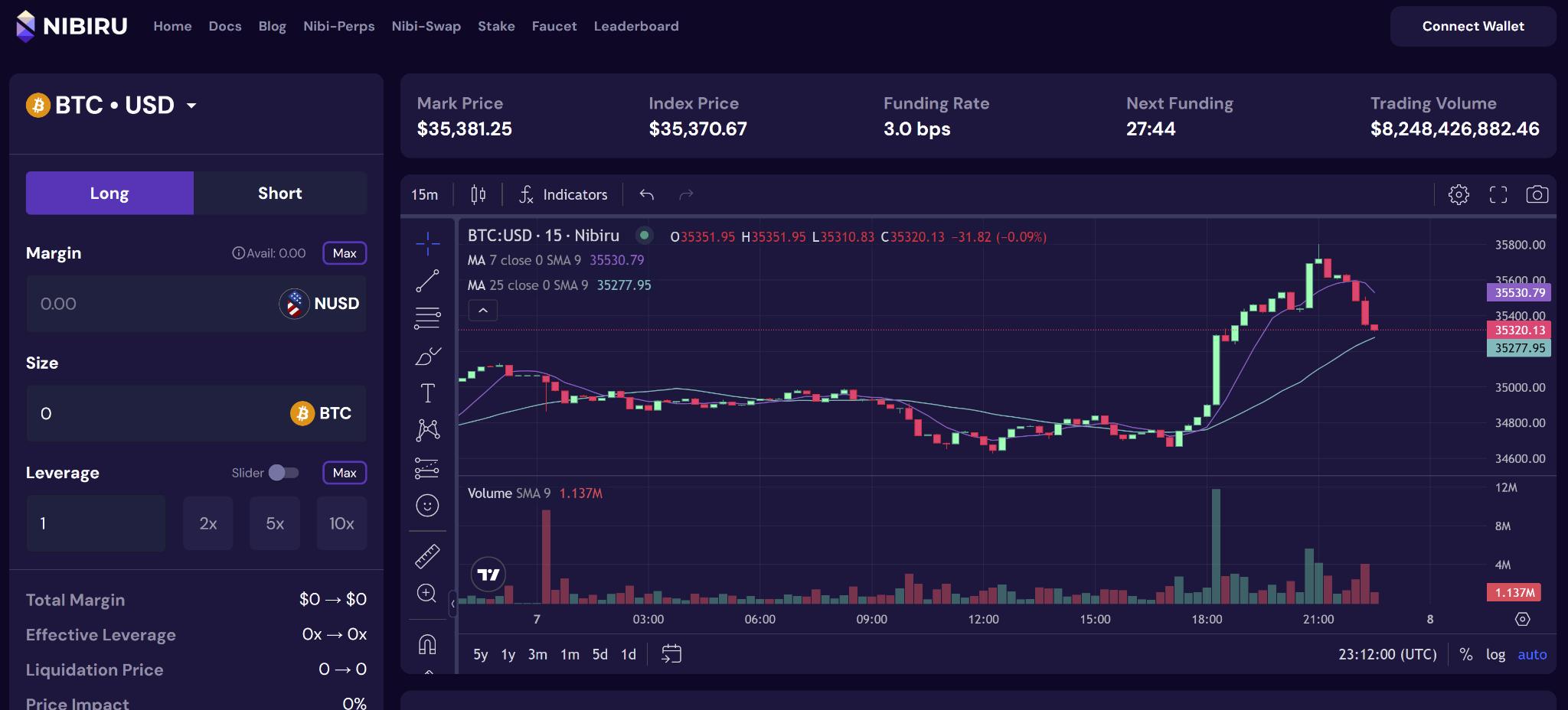
In 2023, Nibiru was developing an early version of Sai for Cosmos. That design used a constant-product virtual AMM without deposited liquidity, similar to Drift's early model. During volatile markets, its max oracle spread limit could make liquidations use the index price rather than the virtual AMM's mark price.
Those mechanics describe the early protocol. See the Sai trading documentation for the current product.
Nibiru has launched its first three phases of its incentivized testnet (see initial statistics). The incentivized testnet thus far has seen approximately 120,000 users, monitored via Google Analytics and the Discord community.
Key benefits of Nibiru include:
- Vertical Integration: Nibiru, a DeFi Hub, offers a USDC-collateralized stablecoin, AMM swaps, and a decentralized oracle network to compliment its Sai product. These elements enhance monetary control, drive network effects, and boost token value.
- Volatility Management: The max oracle spread limit ratio shields users during intense volatility. Additionally, Nibiru uses three backstop layers, including the Ecosystem Fund and Treasury.
- Automated Liquidations Protocol (ALP): Nibiru's system automates liquidations at the smart contract level. This offers streamlined operations with timely liquidations, eliminates liquidator payouts (reinvesting the savings into protocol incentives), and reduces Ecosystem Fund pressure.
- Dynamic Optimizations (Automatic Repeg / Liquidity Depth): Nibiru’s curve repegging automatically aligns terminal and index prices, addressing AMM issues like long/short skews. This results in larger trades, enhanced leverage, and minimized slippage.
- Price Feed Speed: Nibiru’s decentralized oracle network synchronizes oracle and validator incentives, barring front-running and sybil attacks. Updates are swift, occurring every 10-15 seconds.
Let’s Recap
Considering that the first commodity derivative can be traced back to 1849, it is remarkable that perps have only been in existence for just over a few years, and yet have already grown to more than $1T in cumulative trading volumes. Given their features and potential benefits, the opportunity for a surge of traders from traditional finance in exploring decentralized alternatives is exciting to consider.
The intention of this piece was to provide an initial glimpse of the current state of perps, highlighting key players such as GMX, Perpetual Protocol, Drift Protocol, Injective (Helix), dYdX, and, of course, Nibiru itself.
In future pieces, we will delve deeper into both perps themselves and specific projects, providing in-depth analysis and insights into the intricacies of various models and performances. Stay tuned!
About Nibiru
Nibiru is a young, Cosmos-IBC blockchain sporting permissionless Wasm smart contracts and infrastructure improvements optimized for a scalable and secure DeFi ecosystem. Since coming out of stealth in late 2022, several native dApps have been built on the chain (Sai, Nibi-Swap, NUSD, and Oracle Module), and the community has grown to over 120K users with more than 40 projects building on chain.
Nibiru aims to converge the gap between DeFi's potential and the current reality, championing a shift towards simplicity through a Web3 SuperApp, subverting app fragmentation and accruing value cleanly to token holders.
Related Content
- #26 | Innovate. Build. Grow. A Recap on Nibiru's InnovateX Hackathon
- #25 | Nibiru Nilestream: Market Makers
To stay in the loop on upcoming events, sign up for our newsletter or join the community and subscribe to the Nibiru community channels!