#70 | Nibiru’s Fast, Secure, and Unified Multi-VM Communication
· 5 min read
The blockchain space is fragmented. Developers are forced to choose between EVM’s ecosystem, Wasm’s security, and Solana VM’s speed—each with trade-offs. Nibiru’s MultiVM eliminates those trade-offs by embedding multiple virtual machines (EVM, Wasm, and more) into the base layer of a single, high-performance blockchain.
With sub-2-second block times, seamless cross-VM interoperability, and a unified execution environment, MultiVM empowers developers to build complex, feature-rich applications without relying on external bridges or layer-2 solutions. From DeFi protocols leveraging parallel execution to cross-chain dApps benefiting from trustless interoperability, Nibiru’s approach sets a new standard for scalability, security, and developer freedom.
This article explores how MultiVM works, its impact on blockchain architecture, and why it represents the future of Web3 development.
Introducing the MultiVM
Nibiru’s MultiVM approach marks a turning point in blockchain development, combining sub-2-second finality, robust reliability, and frictionless cross-VM interoperability into a single, monolithic chain. Despite never incurring a mainnet outage, Nibiru continues to push boundaries with a major upgrade—originally hinted at in a June 2024 blog post —nearing completion. With security reviews from Code4rena’s Zenith already underway and a second competitive audit kicked off on November 11, the platform is poised for a seamless transition to production-ready status.
By embedding multiple virtual machines directly into the base layer, Nibiru eliminates reliance on external bridges or layer-2 solutions, empowering developers to freely choose among different environments (e.g., EVM, Wasm) for their applications. This design not only ensures unified liquidity and trustless asset management through FunToken but also supports parallel execution for concurrent transaction processing, further enhancing throughput. As a result, end users enjoy a smooth experience with multi-VM dApps that retain both robust security and sub-2-second finality, effectively bridging the best attributes of multiple blockchain ecosystems under one reliable, high-performance roof.
Components of the MultiVM
With Nibiru’s MultiVM, multiple VMs coexist and communicate directly at the protocol level, meaning that this interaction is built into the core software of the blockchain itself on all full nodes rather than relying on additional bridges or layer-2 solutions. This enables to developers to choose between different environments and compose a more diverse array of Web3 applications to bring value to end users.
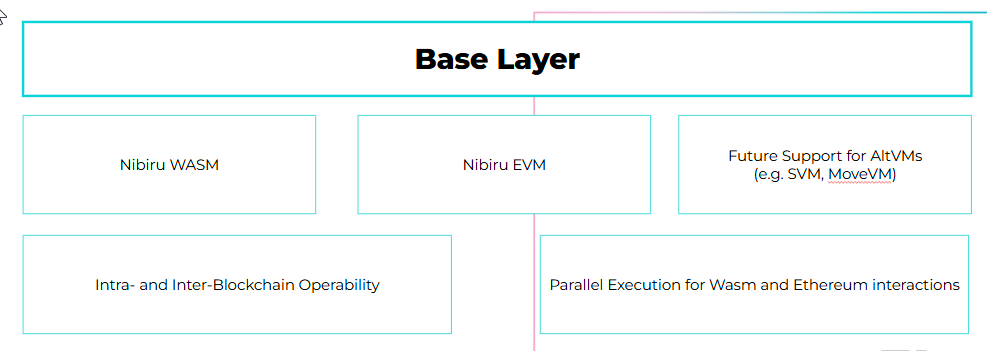
There are a few components that compose the MultiVM:
-
Nibiru Wasm:
Introduced a powerful Rust-based environment that ran on WebAssembly (Wasm) within the Nibiru MultiVM architecture. In contrast to the EVM, Wasm had built-in defenses against re-entrancy attacks—historically one of the most common vulnerabilities in Ethereum. By leveraging a sandboxed execution model and Rust’s compile-time checks for memory safety, Nibiru Wasm dramatically reduced the risk of critical exploits while still delivering near-native execution speeds.
-
Nibiru EVM: Building on the Wasm foundation, EVM **provides a fully compatible, high-performance environment for Ethereum-based applications. Rather than functioning as a sidechain or rollup, the EVM runs as a first-class component on the main Nibiru, offering full EVM-equivalence without the need for external bridges. Developers can seamlessly migrate or deploy Solidity and Vyper contracts, retaining the same developer tools, bytecode, and JSON-RPC APIs used on Ethereum. This integration allows dApps to interoperate with minimal complexity, as the EVM operates in tandem with Nibiru’s other virtual machines under a single consensus.
-
Parallel Execution for Wasm and Ethereum interactions: To ensure high throughput, Nibiru implements a novel parallel execution strategy where non-conflicting VM operations can run concurrently. Static analysis may be used to identify independent state transitions, enabling these operations to proceed in parallel while preserving sequential consistency where necessary. This design achieves sub-2-second finality and maintains the atomicity guarantees developers expect, even in an environment with multiple active VMs.
-
Future Support for AltVMs: Nibiru’s roadmap extends well beyond Wasm and EVM. Recognizing that programming frameworks and languages continue to evolve—from Solana VM (SVM) to Move VM (MVM)—the team is committed to embedding emergent VMs directly into the core software. This approach alleviates the need for separate “altVM” blockchains or disconnected sidechains, letting developers use their preferred languages and toolchains under one unified consensus. By doing so, Nibiru lowers complexity, improves scalability, and welcomes a broader spectrum of developers into Web3.
-
Intra- and Inter-Blockchain Operability: Interoperability stands as a cornerstone of Nibiru’s design, allowing contracts from any VM—Wasm, EVM, or future environments like SVM, MVM, or Privacy —to communicate seamlessly within the chain. They can also connect with external blockchains using the Inter-Blockchain Communication (IBC) protocol and other industry-standard bridging solutions. Whether transferring assets through the FunToken mechanism or invoking cross-chain calls, this unified model provides consistent security, simplified app composability, and frictionless liquidity. By minimizing the need for sidechains or specialized bridges, Nibiru can act as a hub for new and existing blockchain ecosystems alike.
MultiVM as the Modern Solution to Fragmented Developer Environments
Simplified Developer Workflow and User Access
Traditional blockchains often limit users with unfamiliar interfaces that overlook the retail experience. By supporting widely-used applications like MetaMask alongside popular apps from other blockchain ecosystems, Nibiru broadens accessibility and increases the reach of these applications to a larger user base.
These elements form a unified execution environment within Nibiru’s platform, offering users an optimized experience with enhanced efficiency, security, and accessibility. With MultiVM support, end users will be able to utilize smart contracts that harness each respective VM’s advantages, keeping all engineering complexity totally abstracted away from user experience.
VM Wars? Unifying Alternative VMs (AltVMs) with the EVM
AltVMs provide specialized performance and features that address application needs beyond the Ethereum Virtual Machine’s (EVM) scope, yet they often require developers to learn new programming languages—an obstacle to broader adoption. Nibiru’s MultiVM framework solves this by offering EVM compatibility alongside altVM advantages, letting developers tap into the best of both worlds.
Alternative virtual machines, or altVMs, include technologies such as Wasm and the Solana VM, each engineered to overcome the EVM’s constraints around security and processing speed. Although the EVM remains popular due to its extensive ecosystem of wallets, tools, and applications, it lacks the robustness and efficiency that some altVMs deliver—Wasm excels in security while Solana VM stands out for speed.
By unifying these environments, Nibiru’s MultiVM design provides developers with EVM’s broad accessibility as well as the advanced capabilities of altVMs. In this way, there’s no need to choose one ecosystem over another—developers can continue leveraging the widely adopted EVM, while seamlessly integrating altVM features to enhance performance and security wherever needed.
Nibiru Blockchain Architecture
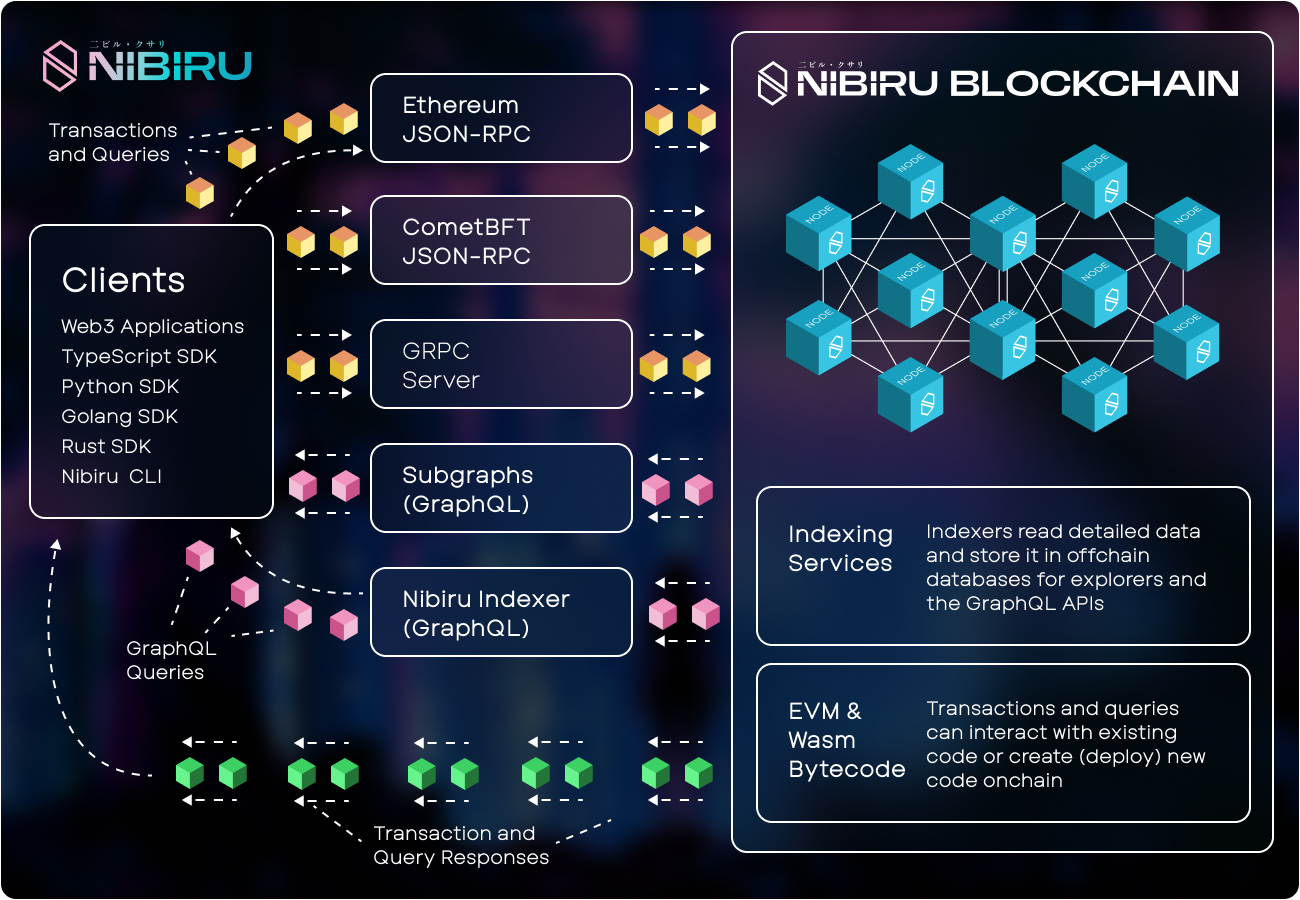
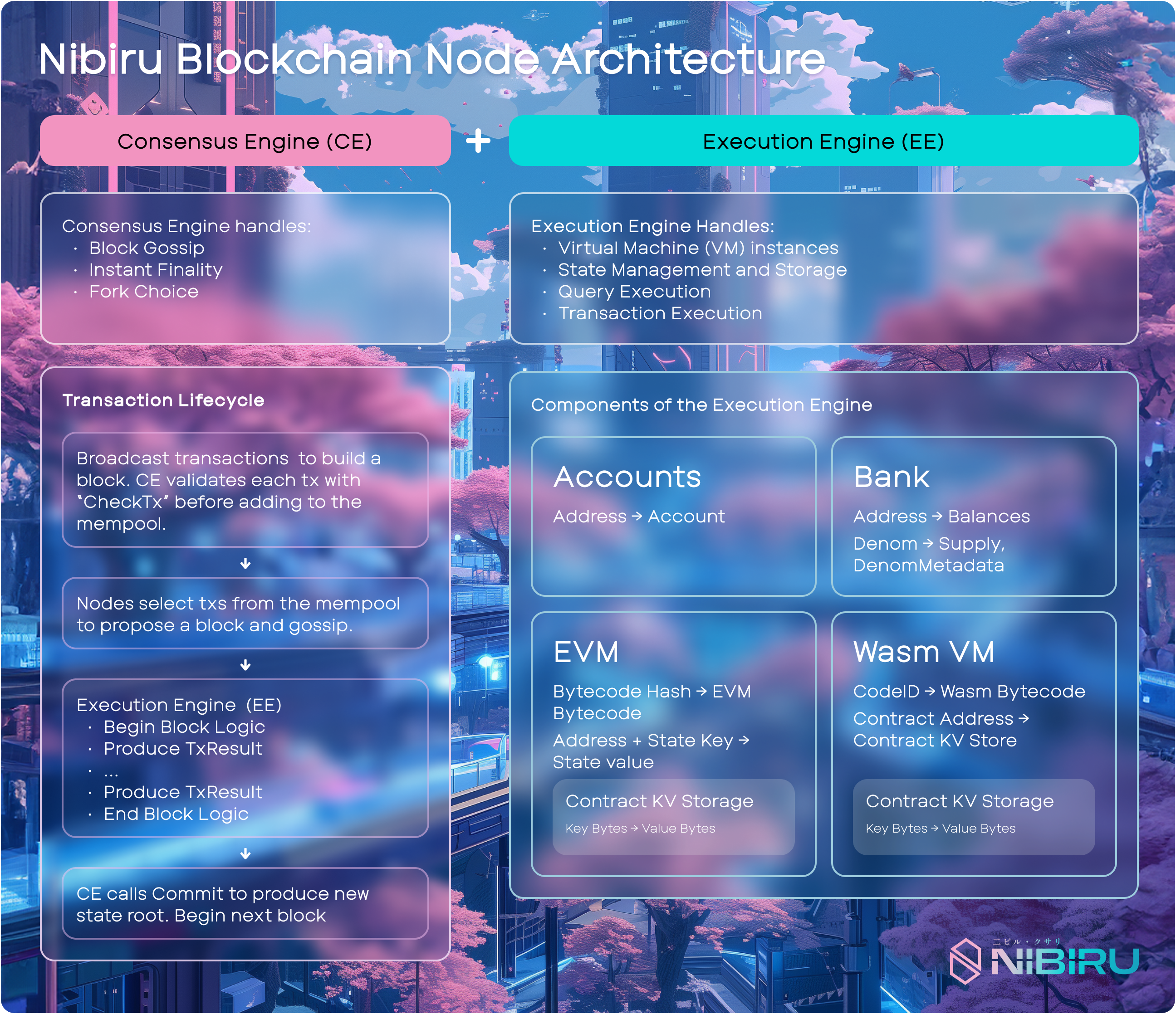
How is the MultiVM environment enabled, and how does it work? To understand the blueprint, let's begin by examining the node architecture. The Nibiru blockchain node architecture is built around two primary engines that work in tandem: the Consensus Engine and the Execution Engine.
- The Consensus Engine (CE) handles block gossip, instant finality, and fork choice, while managing the transaction lifecycle through a process of broadcasting transactions, validating them with CheckTx, and adding them to the mempool. Nodes then select transactions to propose blocks and gossip them.
- The Execution Engine (EE) manages virtual machine instances, state, and transaction execution through four key components: Accounts (mapping addresses to accounts), Bank (handling balances and denomination metadata), EVM (processing Ethereum Virtual Machine bytecode), and Wasm VM (handling WebAssembly smart contracts). Both VMs maintain their own key-value storage systems for contract state. The transaction lifecycle completes when the CE calls Commit to produce a new state root and begins the next block.
How Transactions Flow Through the System
-
Broadcast & Validation: Transactions are broadcast to the network, and the
Consensus Engine (CE) validates each one using a process called
CheckTx. Valid transactions are added to the mempool. -
Block Proposal: Nodes gather transactions from the mempool and propose them as part of a new block.
-
Execution & State Update: The
Execution Engine (EE) processes transactions, updates account balances, executes smart contracts, and stores results.
-
Finalization: The CE commits the block, producing a new state root, finalizing the changes, and beginning the next block.
Execution Engine Components
- Accounts – Maps addresses to user accounts.
- Bank – Manages balances and token metadata.
- EVM – Executes Ethereum smart contracts, mapping bytecode to contract storage.
- Wasm VM – Runs WebAssembly-based smart contracts, providing secure and efficient execution.
Why Unified Execution Engines Matter
Blockchain development today often means working within isolated environments, each with unique capabilities but distinct limitations. Popular virtual machines (VMs) like EVM, Solana VM, and Wasm VM were designed for specific strengths—compatibility, speed, or security—but in isolation, limits what developers can build.
There are limitations with these current VM silos.
- EVM: The Ethereum Virtual Machine (EVM) is widely adopted and compatible with an extensive ecosystem of wallets and tools. But it falls short in areas like speed, parallel processing, and can be vulnerable to certain attacks that are removed at compile time on other VMs.
- Solana VM: Known for its speed, Solana VM (SVM) can handle high transaction rates but struggles with complex computations and offers limited compatibility outside its ecosystem.
- Wasm VM: Offering robust security through isolation and compatible with languages like Rust, Wasm is highly secure but lacks the adoption and tooling available to EVM.
Fragmentation among virtual machines (VMs) forces developers to make difficult trade-offs. Building on the EVM means sacrificing speed, whereas building on the SVM compromises compatibility. As a result, developers either stay confined to one VM’s limitations or attempt cumbersome interoperability through bridges and external solutions—often introducing additional security risks and latency.
But what if those trade-offs weren’t necessary? Imagine a blockchain architecture that brings together the EVM’s ecosystem compatibility, the SVM’s performance, and Wasm’s robust security, allowing each VM to seamlessly complement and compose with the others. This vision underpins the design of the Nibiru blockchain.
In such a setup, developers could build part of their dApp on one VM and the rest on another, leveraging each environment’s strengths without being constrained by its weaknesses. The result? Feature-rich, high-performance applications without the usual overhead of complex interoperability layers.
Real-World Applications
Nibiru’s MultiVM architecture enables atomic execution across virtual machines (VMs) while maintaining network-wide consistency. By allowing multiple specialized environments (e.g., EVM, Wasm, Solana VM, Move VM) to operate as first-class citizens on a single chain, developers can build powerful hybrid applications that tap into each VM’s strengths—without the complexity of external bridges or sidechains.
Cross-VM Derivatives | E.g. Sai
A derivatives platform can coordinate multiple VMs in a single transaction:
- EVM for Order Matching: Leverage Ethereum’s developer ecosystem and tools.
- Wasm for Collateral Updates: Add memory safety and re-entrancy protection.
- Move VM for Risk Calculations: Ensure minimal latency and secure real-time position management.
Cross-Chain DEX | e.g. Euclid and Astrovault
A cross-chain decentralized exchange (DEX) can seamlessly aggregate liquidity and facilitate secure, high-speed trading by leveraging EVM, Wasm, and Move VM within a single, monolithic chain.
- EVM for User-Facing Trades & Liquidity: Familiar wallets like MetaMask handle deposits, swaps, and liquidity provision, reducing friction for Ethereum-native users.
- Wasm for Cross-Chain Aggregation: Rust-based smart contracts manage bridging (e.g., via IBC) and handle routing logic, streamlining multi-chain liquidity sourcing without external bridges.
- Move VM for Advanced Security & Settlement: Resource-based transaction rules ensure robust finality and protect against malicious behaviors—particularly for large, multi-chain liquidity trades.
High-Yield Structured Products (Looping) | E.g. Abracadabra
A high-yield DeFi protocol on Nibiru can enable looping—where users borrow against collateral to reinvest—all within one chain.
- EVM for User-Facing Deposits: Familiar wallets like MetaMask facilitate deposits.
- Wasm for Risk Monitoring: Rust-based contracts secure repeated borrowing and protect against re-entrancy.
- High-Speed VM for Rapid Rebalancing: Handles fast turnover strategies. All actions settle atomically without bridging, reducing complexity and risk.
AI-Enhanced NFT Marketplace | E.g. OpenMark
An NFT marketplace can combine specialized VMs to handle everything on-chain:
- EVM (deepseek + Janus-Pro-7B): Familiar wallets, AI-powered image generation, and minting.
- Wasm for Royalty Logic: Automatically manages royalty splits with Rust-based contracts.
- Solana VM (Eliza AI): Real-time chat assistance and curation for a personalized shopping experience.
- Move VM for High Security: Resource-based rules ensure robust validation of NFT transfers and ownership.
Uncharted Territory: Why Building a MultiVM Blockchain Is So Challenging
Building a chain that embeds multiple virtual machines at the protocol layer is far more complicated than supporting a single VM or relying on layer-2 bridges. Each VM—be it EVM, Wasm, or Solana—introduces its own memory models, gas rules, and transaction handling methods. Unifying them in one monolithic chain demands significant revisions to core consensus and block production logic, making parallel execution especially challenging.
Security becomes a major concern when multiple runtimes share a single underlying state. An exploit in one VM can potentially affect the entire system, so every environment requires rigorous sandboxing and aligned rollback mechanisms. Achieving near-instant finality under these conditions is an added hurdle: if one operation fails in a multi-VM transaction, the entire state transition must revert atomically across all VMs.
Developer tooling is another stumbling block. Mature frameworks exist for single-VM ecosystems (e.g., Truffle or Hardhat for EVM), but debugging and testing cross-VM interactions remains largely uncharted territory. This makes both the learning curve and the need for specialized engineering talent significantly higher—teams must master multiple runtimes and develop new standards in debugging, integration, and security audits.
Finally, organizational demands and costs are non-trivial. Coordinating multi-VM upgrades and ensuring backward compatibility for each environment extends development timelines. Multiple concurrent security reviews can drive up expenses, especially when bridging and cross-chain vulnerabilities already top the list of most expensive blockchain exploits. Consequently, few teams have taken on these challenges, leaving fully integrated multi-VM solutions both rare and groundbreaking.
Behind the Scenes: Nibiru’s Custom Innovations for MultiVM
The talented core team behind Nibiru combines deep expertise from Tendermint and Web2 engineering giants like Google and IBM, blending cutting-edge blockchain knowledge with production-grade software practices. Their prior work on Tendermint and Cosmos provides a unique foundation in consensus mechanics and interoperability, while experience at Google and IBM brings a culture of rigorous testing, reliability, and scalability to the project. This fusion of blockchain R&D with enterprise software engineering is precisely what enabled Nibiru to deliver such a novel, multi-VM solution—one capable of meeting both the high-performance demands of DeFi protocols and the rock-solid reliability expected by enterprise-level deployments.
Beyond core expertise, the Nibiru team also pioneered custom technical solutions to bring multiple VMs under one monolithic chain. They developed a parallel execution engine designed to identify and run non-conflicting transactions concurrently, ensuring sub-2-second block times despite the added complexity of multiple runtimes. Their engineers extended and optimized existing frameworks—such as Go-Ethereum and Wasm—so that both EVM and Rust-based contracts could communicate trustlessly under a single consensus. Additionally, they created new cross-VM modules that handle account management, call data translation, and atomic rollbacks across distinct environments, ensuring a seamless experience for dApps tapping into different VMs in one transaction. These innovations, combined with their experience in distributed systems from Tendermint, are what make Nibiru’s MultiVM both unique and production-ready.
Nibiru's MultiVM Roadmap
To meet the growing demand for seamless cross-chain and multi-chain capabilities, Nibiru has a phased development strategy that begins with cementing EVM and Wasm integration as the bedrock for advanced cross-VM interactions. During this foundational phase, the focus is on delivering rock-solid security and reliability, so developers can confidently deploy contracts on multiple VMs with minimal friction.
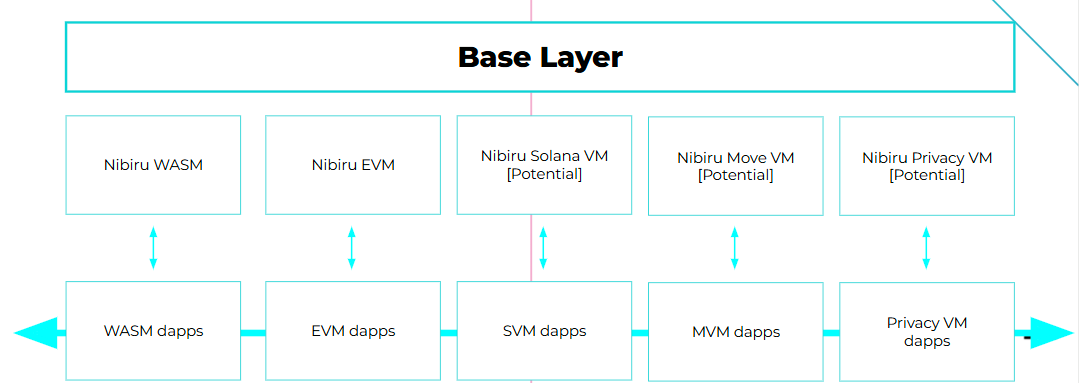
At the heart of this system is the execution engine, which processes and validates transactions, runs smart contracts, and maintains the network’s state. While the consensus engine ensures finality across nodes, the execution engine integrates multiple VMs directly into the blockchain’s core, letting applications operate in once-incompatible environments—such as EVM and Wasm—in a unified way.
In future releases, Nibiru aims to integrate Solana VM (SVM) for high-throughput, computation-heavy applications and Move VM (MVM) for resource-based security. By combining SVM’s parallel execution model with MVM’s strong asset invariants—alongside the existing EVM and Wasm—Nibiru enables a single, atomic execution flow that unlocks more sophisticated dApps.
Additional developer tools will further simplify how dApps harness these different VMs. For instance, a unified tooling suite could provide straightforward CLI and API layers, libraries, and frameworks that automatically handle cross-VM calls, token movements, and state updates. Developers could specify the optimal VM for each part of their dApp—using Rust or Solidity for application logic, SVM for performance-critical transaction batching, and Move for secure asset management—while still benefiting from unified liquidity and security at the protocol level.
Meanwhile, developers can already leverage FunToken to unify liquidity and facilitate cross-chain interactions via IBC. By treating ERC-20 tokens as native assets on Nibiru, teams gain instant access to sub-2-second finality, low fees, and parallel transaction processing—all while enjoying Ethereum compatibility. This tight integration across different VMs sets the stage for a smoother Web3 without requiring users to navigate multiple layers or networks.
From EVM’s vast tooling to SVM’s speed and MVM’s security, Nibiru’s multi-VM blueprint unifies diverse blockchain ecosystems under a single chain—streamlining liquidity, boosting performance, and preserving the frictionless user experience at every step. By eliminating the hurdles of bridging and sidechains, Nibiru lays the groundwork for a cohesive, future-proof Web3 where developers and users alike can focus on building and interacting with next-generation decentralized applications.