#13 | Cosmos Rising: Why so many projects are embracing the Internet of Blockchains
· 7 min read
As the blockchain landscape expands, developers are grappling with critical issues such as scalability, interoperability, and decentralization.
The Cosmos ecosystem aims to tackle these challenges by empowering individual projects to function as distinct Proof-of-Stake (PoS) blockchains, rather than relying on a single PoS platform.
At the core of this vision lies the Inter-Blockchain Communication (IBC) protocol, an innovative messaging framework devised by the Tendermint team. Cosmos-based projects can leverage IBC to securely collaborate while maintaining their independence and sovereignty.
With notable benefits like customizability and autonomy, Cosmos has captured the attention of numerous projects, investors, and developers.
In this article, we will delve into the merits of the Cosmos ecosystem and the reasons behind its growing popularity. We will discuss examples of projects that have chosen to build on Cosmos, including Circle, Injective, Sei Network, Evmos, and others. Furthermore, we will explore why blockchain research and development (R&D) firm Delphi Labs selected Cosmos as their new home following Terra's collapse.
This article will compass the following topics:
- The rationale behind various projects' decisions to deploy on Cosmos, featuring Circle, Injective, Sei Network, Evmos, and more.
- The reasons that led established blockchain R&D firm Delphi Labs to choose Cosmos as their new headquarters after Terra's implosion.
- An overview of the distinguishing factors that set Cosmos apart from other networks.
- The future trajectory of the Cosmos ecosystem.
Our goal is to provide the reader with an educated perspective on how Cosmos fits into the greater blockchain space and why so many are electing to build on it.
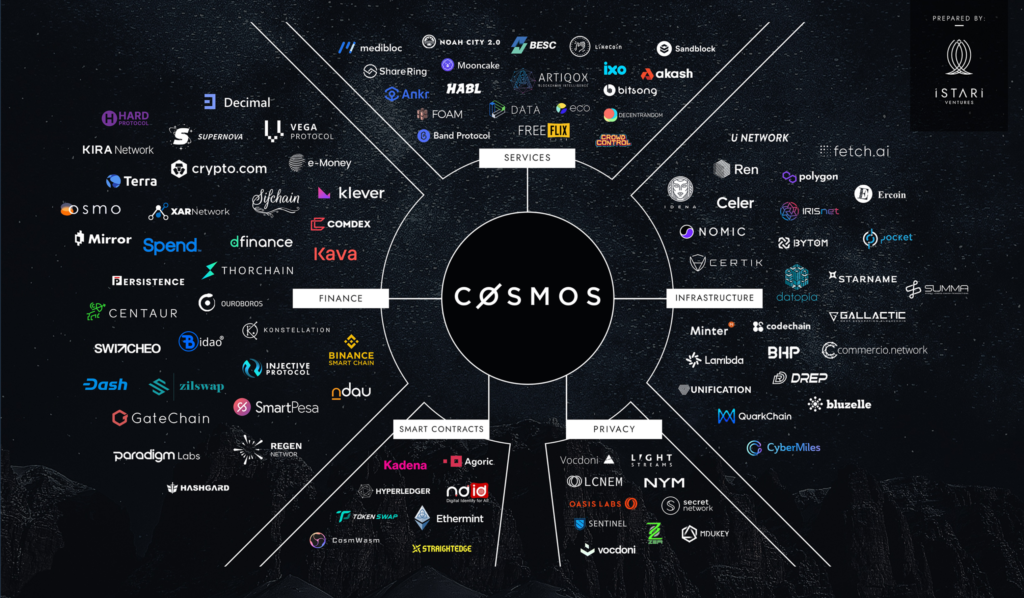
Projects Building on Cosmos
In this section, we will explore six diverse projects thriving on Cosmos, spanning a range of DeFi topics such as stablecoins, derivatives, infrastructure, and more. Our objective is to offer insights into why these projects have opted for the Cosmos network and highlight the exciting advancements that are either well-established or in progress. By examining these various projects, readers can gain a deeper understanding of the myriad use cases that Cosmos can support within the DeFi ecosystem.
dYdX
Since its inception, dYdX has been a leading Ethereum-based perpetual swap protocol. In late 2022, the team announced that dYdX V4 would transition to its own blockchain, built on the Cosmos SDK and Tendermint Core consensus. This decision was driven by several factors:
- Throughput: Operating on their own Cosmos-based blockchain offers higher throughput, well-suited for their order book architecture. This is particularly crucial for derivatives transitioning to a fully on-chain nature.
- Customizability: dYdX desired greater control over their technology stack. For instance, they chose to establish their own validator set to handle off-chain transactions, reducing network congestion.
- Interoperability: While interoperability can be difficult on Ethereum, dYdX Chain can seamlessly interact with other IBC-enabled projects.
- Gas Fees: On Ethereum, fees are paid in ETH. In contrast, on Cosmos, the team decided to eliminate gas fees and collect trading fees in their token, thereby accruing value to it.
As the first high-profile Ethereum project to make the switch, dYdX can be seen as a pilot for other non-Cosmos projects considering a similar move. This is particularly exciting, as it not only demonstrates their confidence in Cosmos but may also encourage others to follow suit, establishing a trajectory for future projects.
Sei Network
Sei Network, a Cosmos-based Layer-1 platform, addresses the lack of DeFi-specific chains, the limited exploration of order books, and the subpar DeFi user experience. The platform offers a customizable order book infrastructure for trading with ultra-fast transaction finality (600ms) and high throughput (22,000 operations per second). For comparison, Solana mainnet sees 600-700ms block times with ~2,500 transactions per second (theoretical TPS is often cited as 60,000).
In early 2023, Sei received a considerable boost when over 100 dApps launched on the platform, and Sushiswap, a leading Ethereum-based DEX, announced its expansion into perpetual trading by acquiring the Sei-based Vortex Protocol. This strategic move for Sushiswap signifies a positive development for the ecosystem and enables the optimization of an order book-style perpetual swaps protocol, which would be challenging on Ethereum due to network limitations.
Evmos
Evmos was built using the Cosmos SDK with the intent of building out an EVM stack on Cosmos that would bring over existing EVM community members while also benefiting from unique Cosmos traits such as high interoperability. In particular, they enable cross-chain deployments whereby a dApp is deployed on Evmos and is then usable via various blockchain networks, rather than being deployed separately onto each. This is made possible with the Evmos SDK.
The Evmos SDK is a combination of modules that allow the creation of EVM-compatible, Tendermint PoS chains, each equipped with the tools to communicate via IBC like cross-chain token transfers, interchain accounts, and interchain queries.
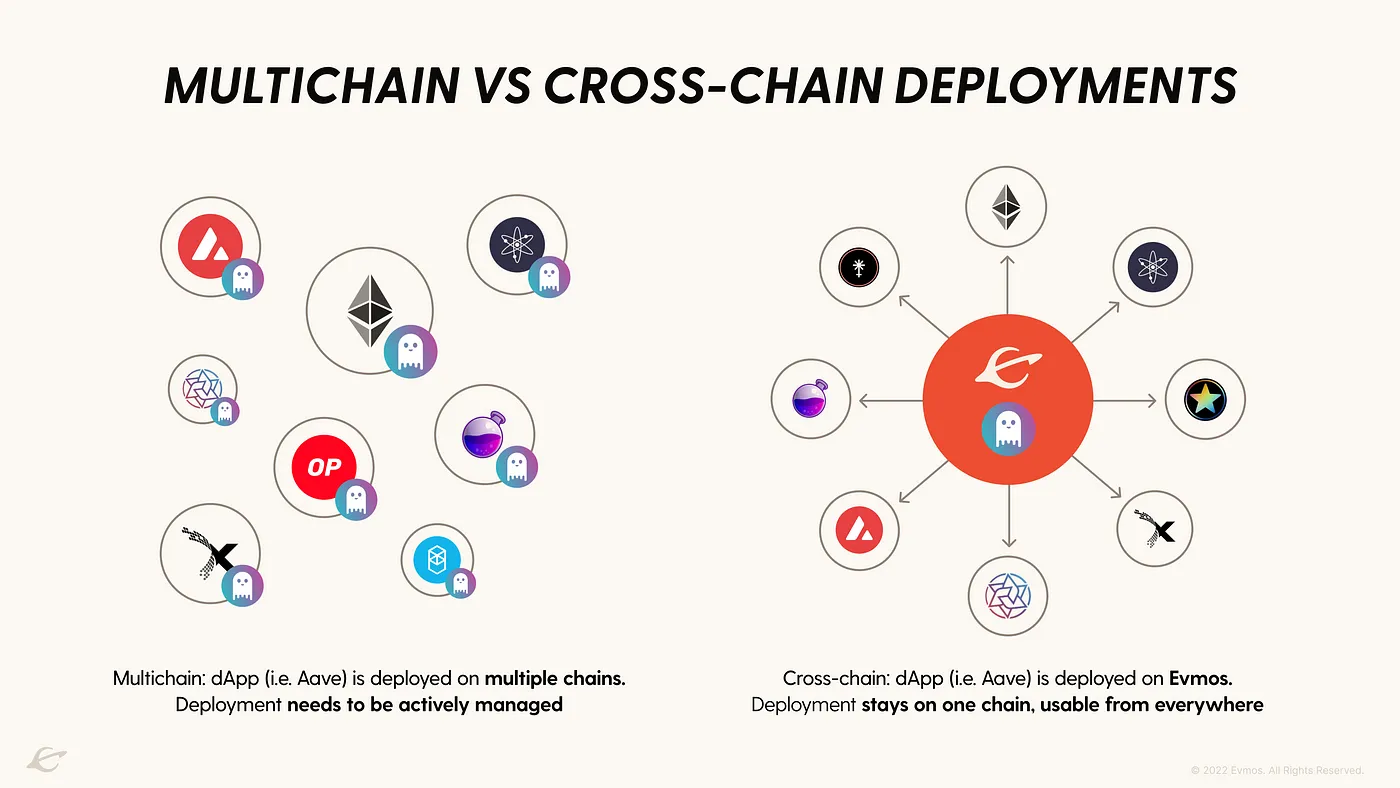
With the EVM runtime native to each chain, Evmos marries the developer friendliness and extensibility of the EVM with interoperability of IBC. As a result, Evmos has attracted significant interest from users and investors alike.
The team also established the predecessor mechanism for Juno’s fee-sharing and Canto’s Contract-Secured Revenue with the Evmos Revenue Module, which provides an innovative way to distribute transaction fee revenues by allocating them between block proposers and smart contract deployers, creating income sources for smart contract developers in a pay-per-transaction model.
Canto
Canto is one of the newer Cosmos chains that spawned from the Evmos SDK. Canto interestingly combines the architecture of Compound’s lending market and Solidly’s decentralized exchange, while also introducing their own unique stablecoin, NOTE. Canto saw an impressive surge in activity, reaching the hundred millions in both TVL and volume this year.
Berachain 🐻⛓
Berachain is another Evmos SDK chain centered around DeFi. Berachain is a bear-themed project that has seen some of the most VC excitement of any IBC chain, raising a whopping $42 million in a Series A round led by Polychain Capital at a $420.69M valuation, which was announced on 4/20.
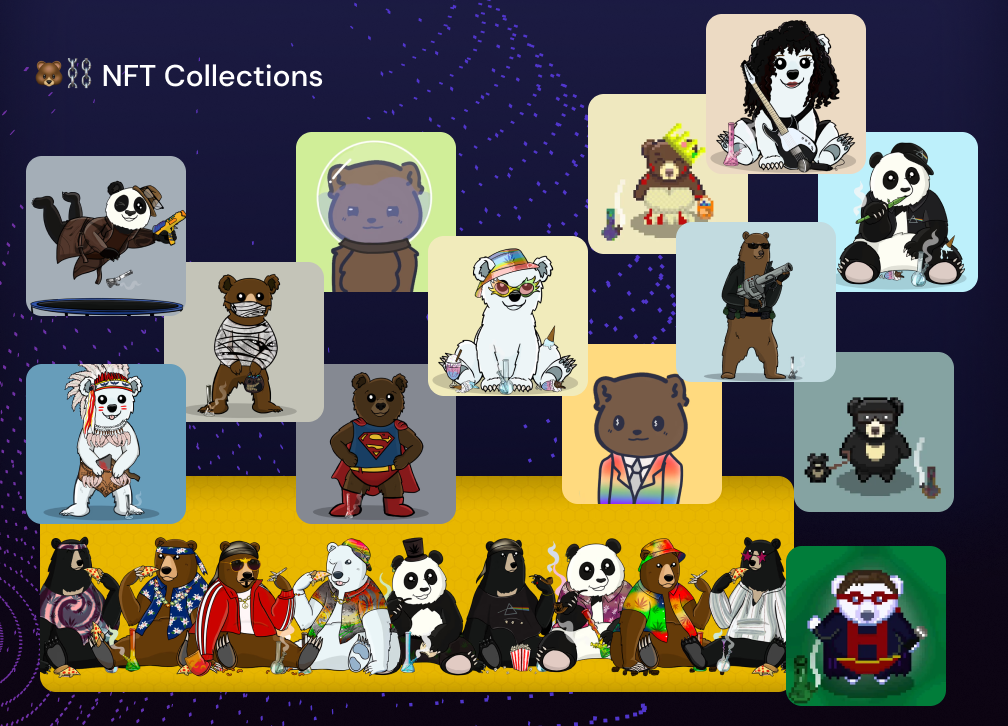
Before Berachain started the L1, origins began in 2021 with the Bong Bears NFT collection, “100 absolutely zooted NFT bears getting baked.” The Bong Bears rebasing mechanism was inspired by OlumpusDAO’s OHM and eventually led to the creation of several bear-themed collections like Bond Bears, Boo Bears, Baby Bears, Band Bears and Bit Bears.
The Berachain team recently released the Polaris Virtual Machine, a general-purpose blockchain framework that allows for EVM integration into any underlying networking or consensus layer. Polaris offers the same composability and modularity benefits as the original Evmos modules with several performance improvements.
Proof-of-Liquidity and the 🐻⛓ Flywheel
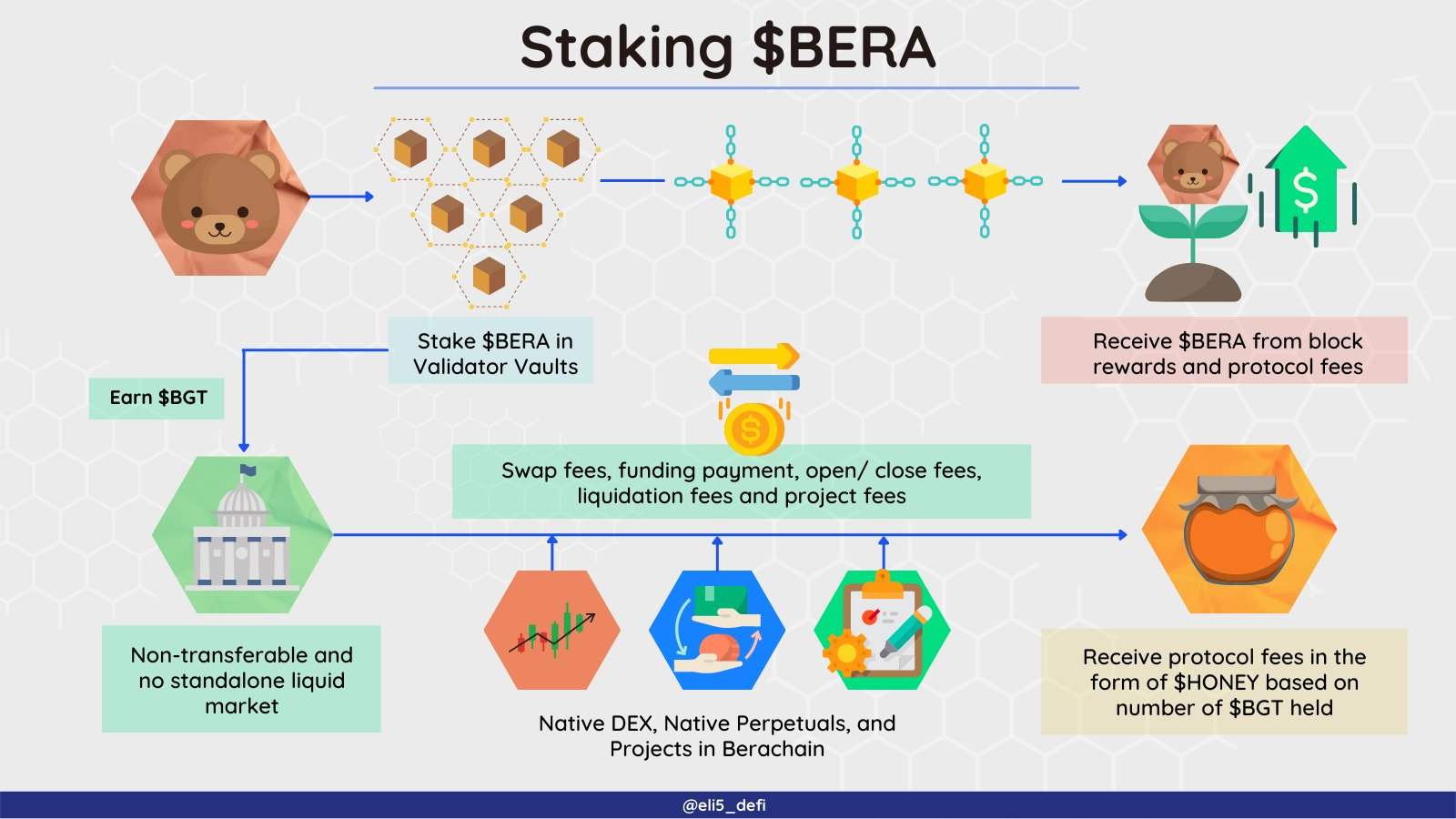
Berachain combines three native tokens: BERA for gas, HONEY as its native, over-collateralized stablecoin, and BGT for governance. The chain has a feature called proof of liquidity, where users can participate in delegated proof of stake to secure the network using native and non-native assets.
- Purchase BERA or other assets.
- Staking BERA gives rewards in both BERA and BGT, but you can also stake tokens like BTC, ETH, etc., in which case you’d only receive rewards in BERA.
- Use BGT for governance. Holding more BGT increases the yield received in HONEY while using applications on Berachain.
- Use HONEY as collateral to take out loans.
Circle USDC via the Noble Network
Cosmos is set to welcome Circle USDC through the Noble Network, an exciting development considering Cosmos has historically lacked a native USD-backed stablecoin, a crucial infrastructure component. While wrapped stablecoins like axlUSDC and gravUSDC have already been deployed on Cosmos, they face challenges such as liquidity fragmentation and bridge risks.
Native USDC will be implemented using Circle’s Cross-Chain Transfer Protocol (CCTP), which can burn USDC on a source chain and then mint them on a designated destination chain. This approach is more efficient and secure than the lock-and-mint bridge design commonly used for wrapped tokens.
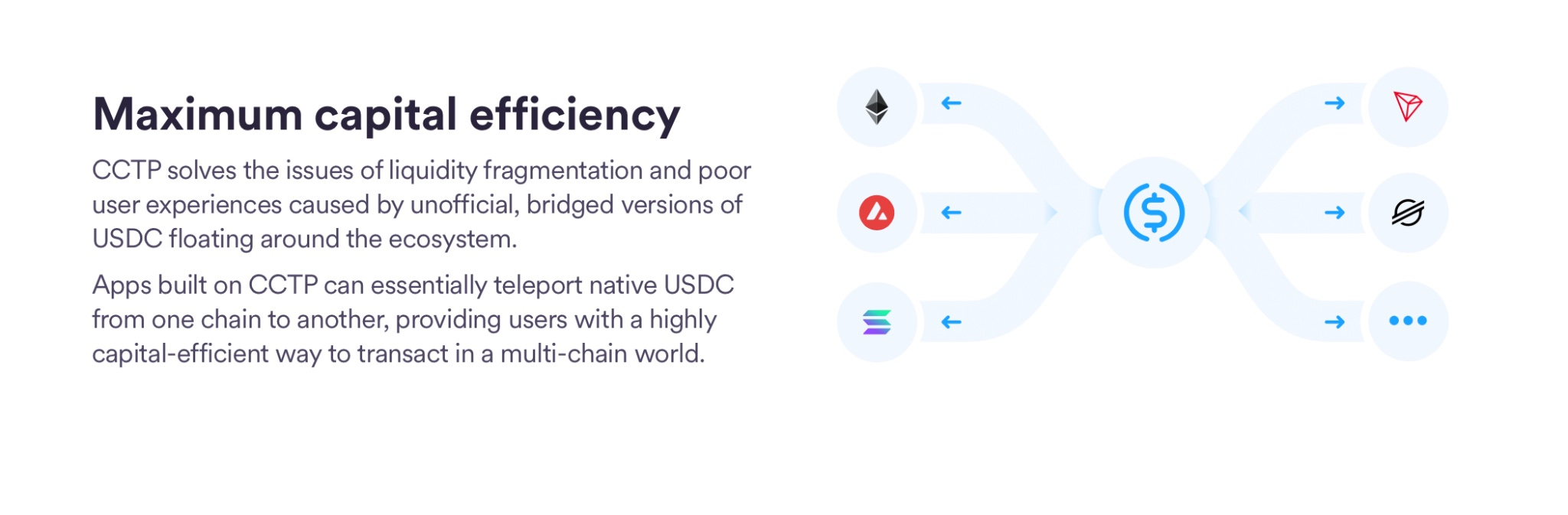
At present, USDC is natively issued on only eight chains, making its decision to launch on Cosmos a significant vote of confidence. It is likely that Circle anticipates more liquidity and users joining Cosmos in the near future, positioning itself as the preferred USD-backed stablecoin. -->
Injective
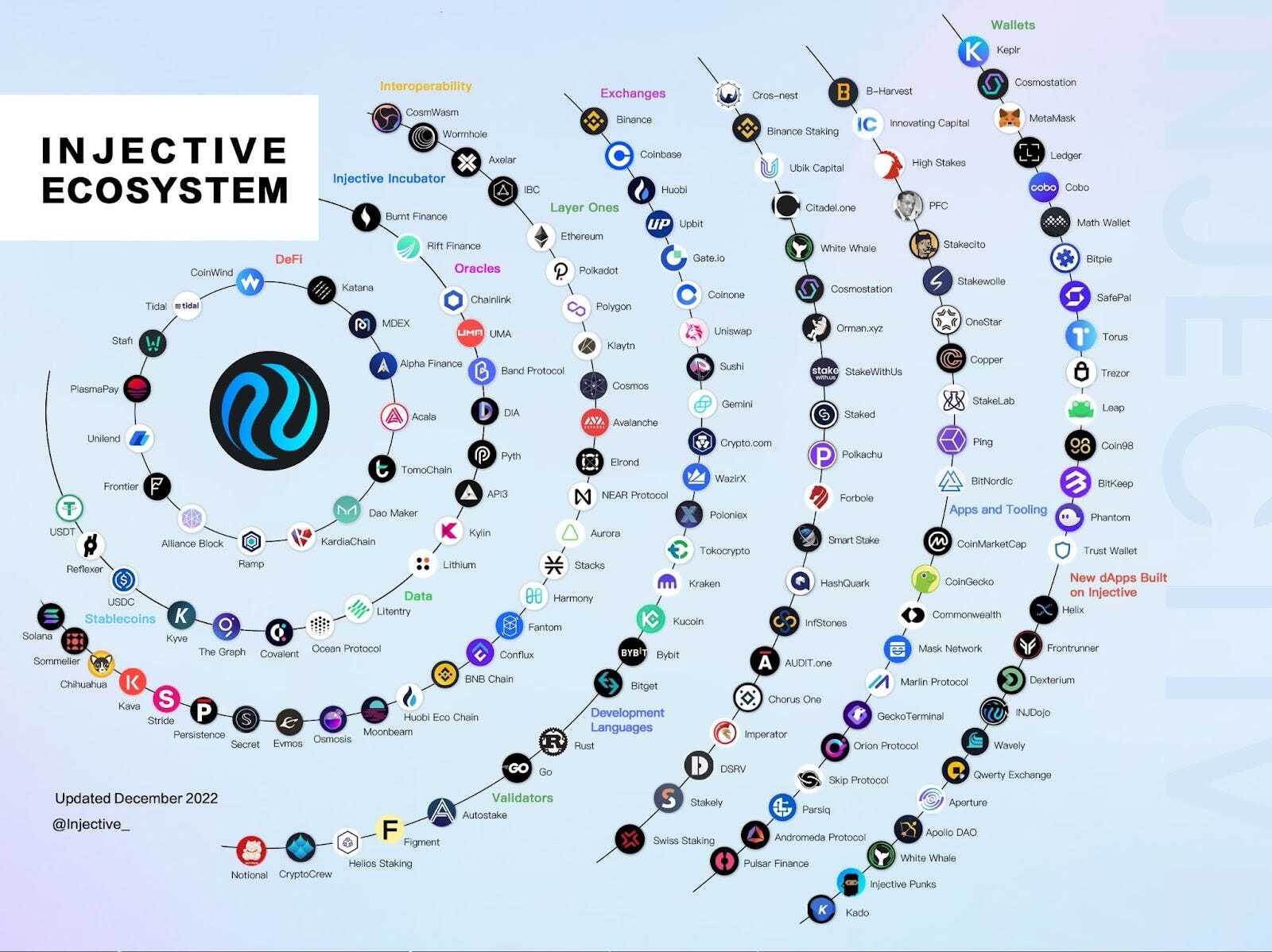
Injective is a Cosmos-based and Ethereum-compatible decentralized smart contract platform that enables the access, creation, and trading of DeFi markets, including crypto, futures, perpetuals, and sophisticated derivatives. It supplies plug-and-play modules for developers to craft customizable dApps, encompassing exchanges, options, derivatives, and lending protocols.
Injective Chain is a fully decentralized sidechain relayer service, while Injective Exchange Service is the front-end interface users interact with. Exchanges built on Injective Chain allow users to trade with zero gas fees and fast transactions. The protocol's native token, INJ, is used for governance, exchange value capture, liquidity mining, and staking.
Injective Protocol was incubated by Binance Labs in 2018 and launched its mainnet in November 2021 with a $120M incentive program. It features unique aspects such as collision resistance, isolated risk coverage, and gasless trading.
In late January, Injective Labs unveiled the Injective Ecosystem Group, a venture initiative featuring prominent venture firms such as Pantera Capital, Kucoin Ventures, Kraken Ventures, Jump Crypto, and others. The group's inaugural $150 million ecosystem fund aims to nurture new projects in areas like DeFi, trading, rollups, interoperability, and more. Similar to Circle, this move signals substantial confidence in Cosmos and promotes the development of novel projects.
Delphi Labs Chooses Cosmos
Delphi Labs, a renowned blockchain research and development division of Delphi Digital, was deeply invested in Terra before its collapse in May 2022. Boasting a team of over 50 top-tier blockchain researchers, the pressing challenge was to determine the most appropriate ecosystem for Delphi Labs' next chapter. This pivotal decision prompted an extensive report that analyzed and compared various ecosystems.
Background: Delphi Labs in Search of a New Ecosystem
As a division of Delphi Digital, Delphi Labs is a blockchain R&D division that formerly operated within Terra. Following Terra's collapse in May 2022, they confronted the decision of choosing their next direction. This significant choice led to an in-depth report analyzing the best fit for Delphi Labs. With a team comprising more than 50 top-tier blockchain researchers, the decision carried considerable weight.
Why Cosmos: Key Factors in Delphi Labs' Decision
Ultimately, Delphi Labs selected Cosmos as the most fitting ecosystem. A core belief driving their analysis was the expectation that future blockchains will shift from monolithic structures to specialization-focused, multichain ecosystems.
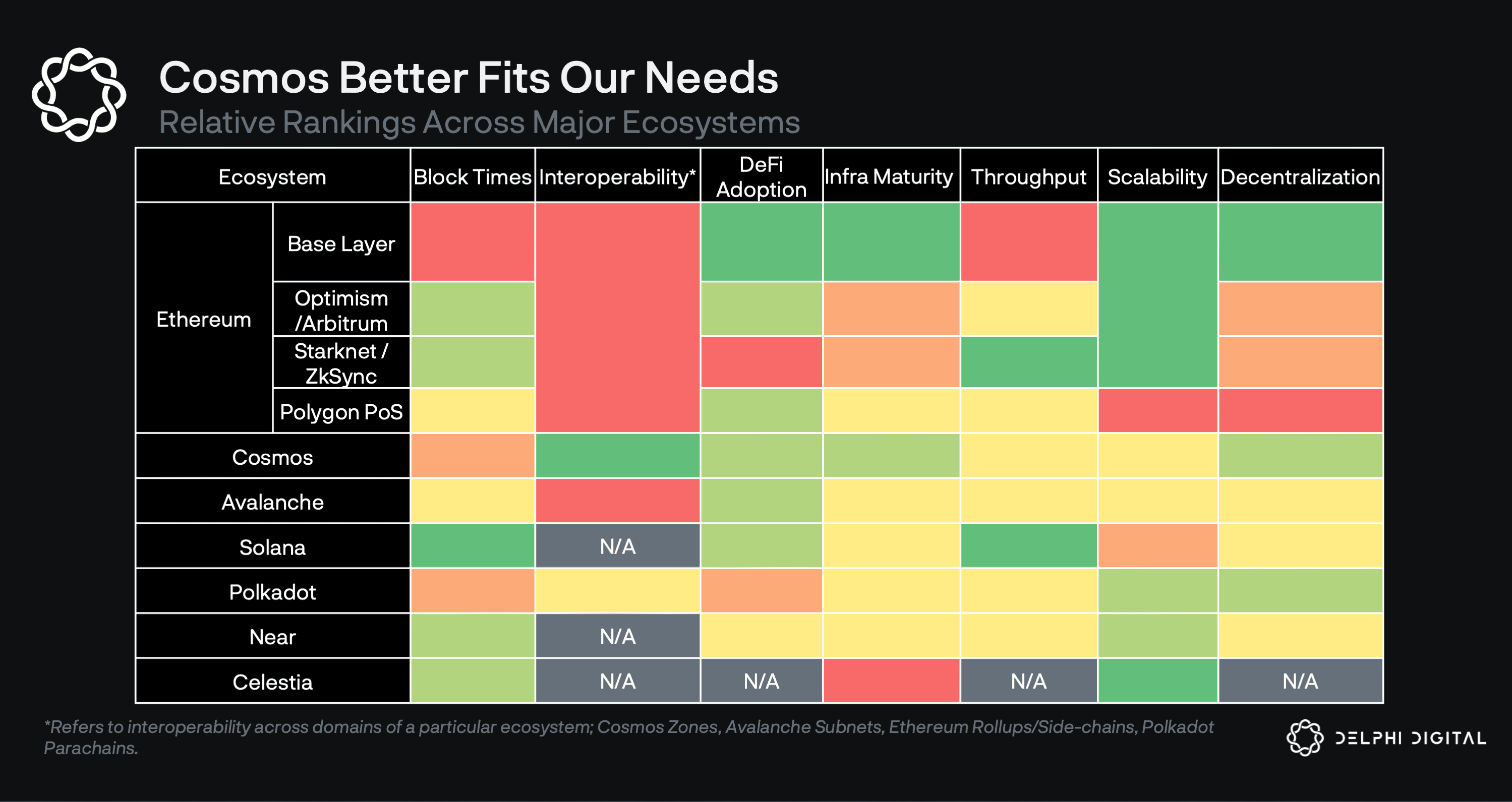
Delphi presented a comprehensive framework for evaluating the pros and cons to each major blockchain ecosystem. Cosmos’ most notable advantage is its advanced interoperability facilitated by IBC. Additionally, Cosmos boasts a mature infrastructure, growing DeFi adoption, and a decentralized architecture.
“We believe that the space will increasingly fragment into a mesh network of generalised smart contract chains and specialised app-chains connected via trust-minimised bridges. In such a world, multiple DeFi hubs will emerge, each with their own set of tradeoffs, ecosystems, and communities. DeFi dApps that are deployed on multiple platforms, with well-designed architectures, will benefit from liquidity and other network effects that will make it difficult for local DeFi dApps to compete. We feel Cosmos is best positioned to both benefit from the increasing number of app-chains and enable the most advanced cross-chain architectures.
In addition, it’s also fast enough to enable a seamlessly integrated DeFi UX with order books, high leverage, and fast trading execution. At the same time, we feel it’s sufficiently decentralised to provide strong security, liveness and censorship-resistance guarantees, especially when compared to many of the alternatives we considered which are more nascent and thus have more centralisation vectors.” - Delphi
In-Depth Analysis: Examining the Attributes of Cosmos
Delphi Labs' evaluation focused on several aspects:
- Block Time / Throughput: Cosmos allows customization of both data storage and consensus, enabling low block times and high throughput. Most Cosmos-based chains such as the Cosmos Hub, Terra, and Osmosis report block times of 6 seconds. Newer chains such as Evmos, Sei, Injective, and Nibiru boast impressive block times of 1-2 seconds.
- Interoperability: The Inter-Blockchain Communication (IBC) protocol is extremely secure and efficient, connecting various Cosmos-based projects with one another. Projects may also communicate outside of Cosmos via solutions such as Axelar Network, Gravity, Terra, and Noble.
- DeFi Adoption: Cosmos has gained recognition and attracted top-tier researchers and builders. Though its TVL lags behind networks like Ethereum, the number of core contributors and community members has steadily increased.
- Infrastructure Maturity: Cosmos began in 2014 and is quite established, making it less subject to attacks, downtime, etc. For more information, check out our last blog post detailing the history of Cosmos. The ecosystem is highly regarded for its engineering talent, the Cosmo SDK, Tendermint consensus, and more.
- Scalability: Each Cosmos project operates as its own PoS chain, improving scalability and throughput. Consensus and data storage optimizations are ongoing, with projects like Optimint working to enable rollups via Celestia, a Cosmos-based chain. However, the practicality of this approach for widespread global use remains uncertain.
- Decentralization: Although the number of validators isn't massive, the “Nakamoto Coefficient” is similar to Ethereum's level. Core development is distributed among various independent research teams.
Delphi Labs' Vision: Specialized Blockchain Ecosystems
Delphi Labs envisions a collection of specialized blockchains capable of seamless communication with one another. Cosmos best aligns with this vision, despite receiving moderate scores in certain dimensions, such as scalability and throughput.
Reflecting on Delphi Labs' Analysis
The majority of Cosmos chains have block times around 6 seconds. However, newer chains like Nibiru have significantly reduced block times to 1-2 seconds, implying a potentially higher transaction throughput than the standard ~10,000 for 250 byte transfers.
As an interconnected network of blockchains, Cosmos promotes horizontal scaling, allowing new applications to take advantage of its customizable Cosmos SDK modules and Tendermint Core consensus mechanism. BNB Chain, built with Cosmos SDK and utilizing Tendermint consensus, serves as a solid example of battle-tested scalability.
Cosmos stands apart from its competitors by effectively addressing the interoperability challenge through its existing IBC, while also tackling common scalability issues. Its decentralized nature, free from reliance on a centralized validator set or governing entity, further strengthens its position.
Considering Delphi's insights and the broader context of layer 1 ecosystems, Cosmos emerges as the only solution that successfully addresses interoperability, scalability, and decentralization. This unique combination has drawn an increasing number of projects to build on Cosmos, potentially marking a turning point for growth.
As the cryptocurrency landscape continues to evolve, Cosmos is well-positioned to benefit from an increasingly fragmented and interconnected blockchain ecosystem.
Piecing It All Together: Why Cosmos?
We've explored various factors that have prompted projects to build on Cosmos. In summary, the key reasons include:
1. Customizability
While building on networks like Ethereum is straightforward, their rigid frameworks may not suit all projects. Cosmos offers the flexibility for projects to customize their tech stack as needed. This was a significant reason why Nibiru is launching as an IBC chain, despite the more mature DeFi landscape available on other networks.
CosmWasm and the Cosmos-SDK enable us to seamlessly vertically integrate our perpetual -swaps, spot AMM, fully-collateralized stablecoin, decentralized oracle network, and more. Moreover, we adjusted block times, consensus, and other aspects of our tech stack.
As blockchain use cases expand in unforeseen ways, having customizability from the ground up ensures the right infrastructure for projects to develop tailored solutions. This is a major differentiator for Cosmos and a driving force for projects migrating to the platform.
2. Interoperability
With over 175 blockchains listed on DeFiLlama, seamless transfer of value and information is essential. The Cosmos IBC protocol offers the perfect solution for IBC-enabled chains, while Cosmos continues to connect with external blockchain networks through native USDC issuance and solutions like Evmos and Canto.
In the future, there could be various blockchain networks tailored to specific purposes, such as for U.S. universities or city public transit systems. Building on Cosmos might be the ideal choice for these projects, facilitating efficient and secure communication with others.
3. Growth
Blockchain ecosystems strive to attract robust developer communities, who in turn create products that foster innovative projects, attract users, and increase TVL. Cosmos has already drawn top-notch founders and developers, boasting one of the most prominent core blockchain developer communities. Its advanced technological infrastructure primes Cosmos for substantial DeFi growth, explaining why many existing projects have migrated, even though TVL remains modest compared to some established competitors.
However, a current limitation is the number of developers learning the Go programming language, required for the Cosmos SDK. In recent years, Solidity has become popular, and based on online analysis and conversations at industry conferences, it appears that this Ethereum-based language is attracting most new graduates. To accelerate developer growth on Cosmos, the Go programming language needs to gain traction.
What's Next?
The Cosmos whitepaper was unveiled in 2016, and the Cosmos Hub emerged as the inaugural zone in the network in 2019. Although it is easily recognized by those well-versed in the ecosystem, Cosmos has yet to gain extensive popularity. This might stem from the fact that Cosmos' distinguishing features are its appealing technology stack, which includes IBC, Tendermint Core, and the Cosmos SDK, thus attracting a predominantly developer-centric audience. Furthermore, the interoperability-focused IBC was only just introduced in 2021, alongside the Cosmos upgrade, Stargate.
That being said, with numerous new projects joining Cosmos, including dYdX V4, Sei, Evmos, Canto, Berachain, Noble, and Injective, the system is undoubtedly reaching an inflection point. The influx of additional high-profile projects from Ethereum and other blockchains is expected to further accelerate this growth. As the diverse set of applications and use cases increases, the ecosystem will naturally attract heightened interest and liquidity.
About Nibiru
Nibiru aims to create a next-generation DeFi hub, integrating leveraged derivatives trading, spot trading, staking, and bonded liquidity provision. As a secure, transparent, and self-custodial trading hub, Nibiru stands out in the fast-evolving DeFi ecosystem by offering enhanced interoperability and a one-stop shop, full-stack user experience.
Trading on Nibiru should feel like trading on a centralized exchange, with the notable differences being the absence of off-chain settlements, discretionary custodying of funds, "keeper" networks, and external liquidators. Everything on Nibiru is driven by smart contracts and automation, enhancing accessibility and ease-of-use in the decentralized exchange ecosystem.
Nibiru aggregates the value of all financial activities (trading, yield generation, staking) to a single token, NIBI, avoiding fragmentation and over-reliance on external blockchains. This approach democratizes DeFi and prioritizes builders.
🔮 Docs | 👾 Discord | 🐦 Twitter | 🔥 Web App⛓️ ️Explorer | 🌴 Link Tree | 👨💻 Code