
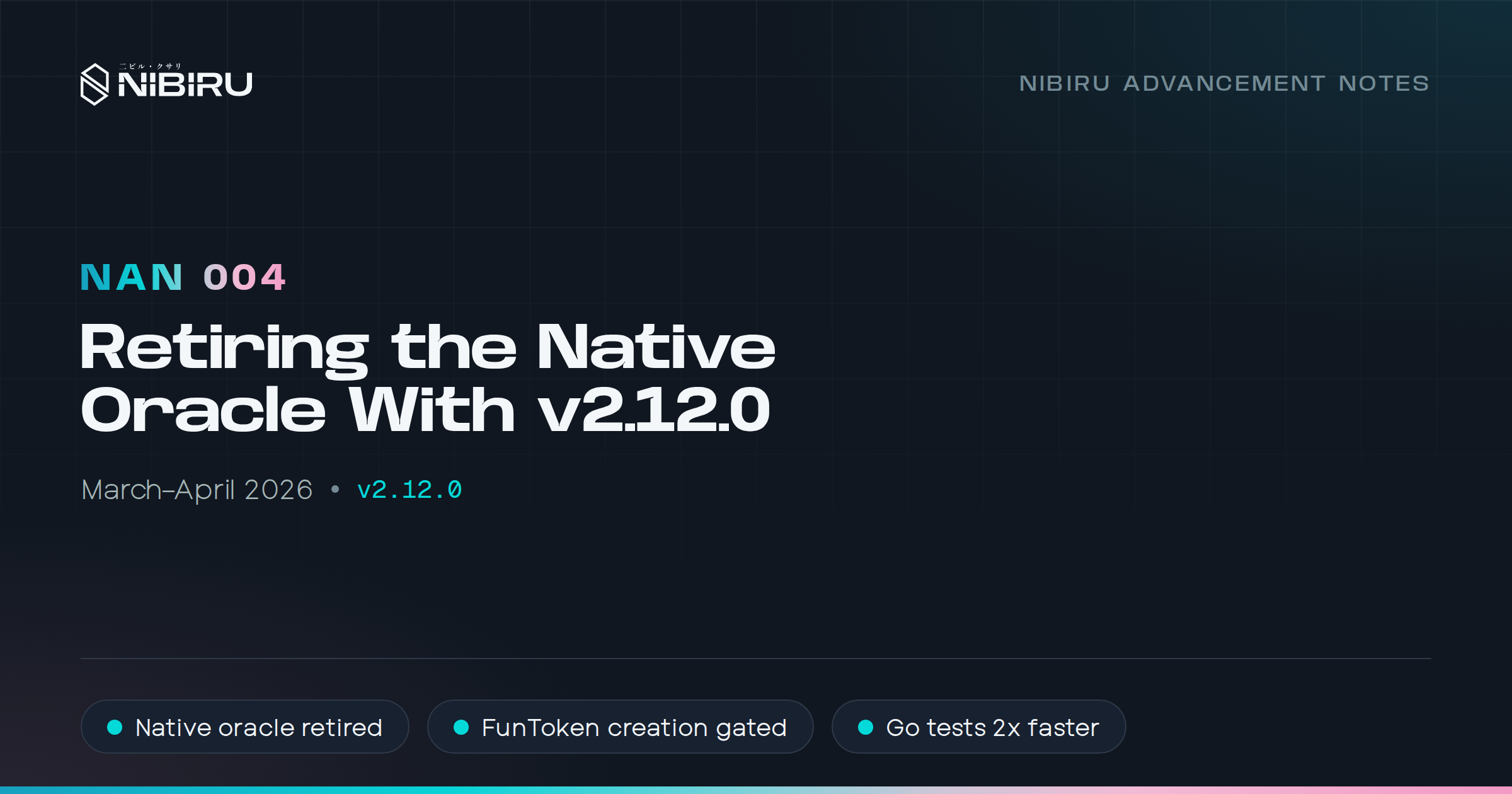
NAN 004: Retiring the Native Oracle with v2.12.0
Posted by Unique on 2026-04-30. Release: v2.12.0. Prior mainnet upgrade: v2.11.0.
Summary
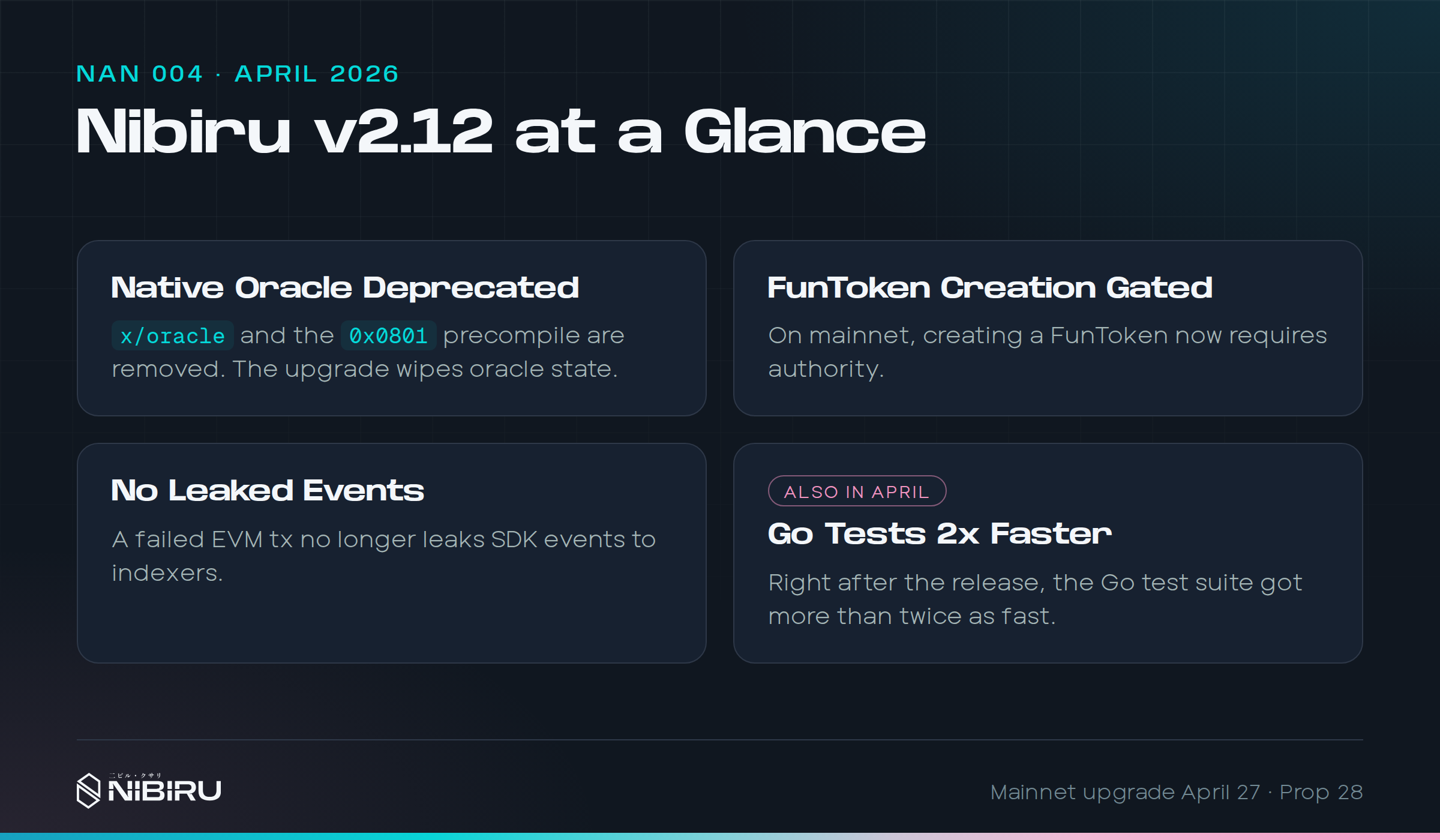
- Validators are out of the price business. The chain's built-in oracle is retired, so validators no longer vote on prices or get slashed for missing a vote. The upgrade clears the oracle's stored data.
- EVM contracts can no longer read prices from
0x0801. The old oracle precompile is gone, along with its Solidity interfaces in@nibiruchain/solidity. - Mapping a token between the Cosmos and EVM sides needs approval on mainnet. Creating a FunToken is no longer permissionless there.
- Indexers stop seeing events from failed EVM transactions. Work the EVM rolled back no longer shows up as Cosmos events.
- Our Go test suite runs more than twice as fast.
March had no release. Most of that month went into the work that landed here, so this note covers both months.
1) Why we turned off the native oracle
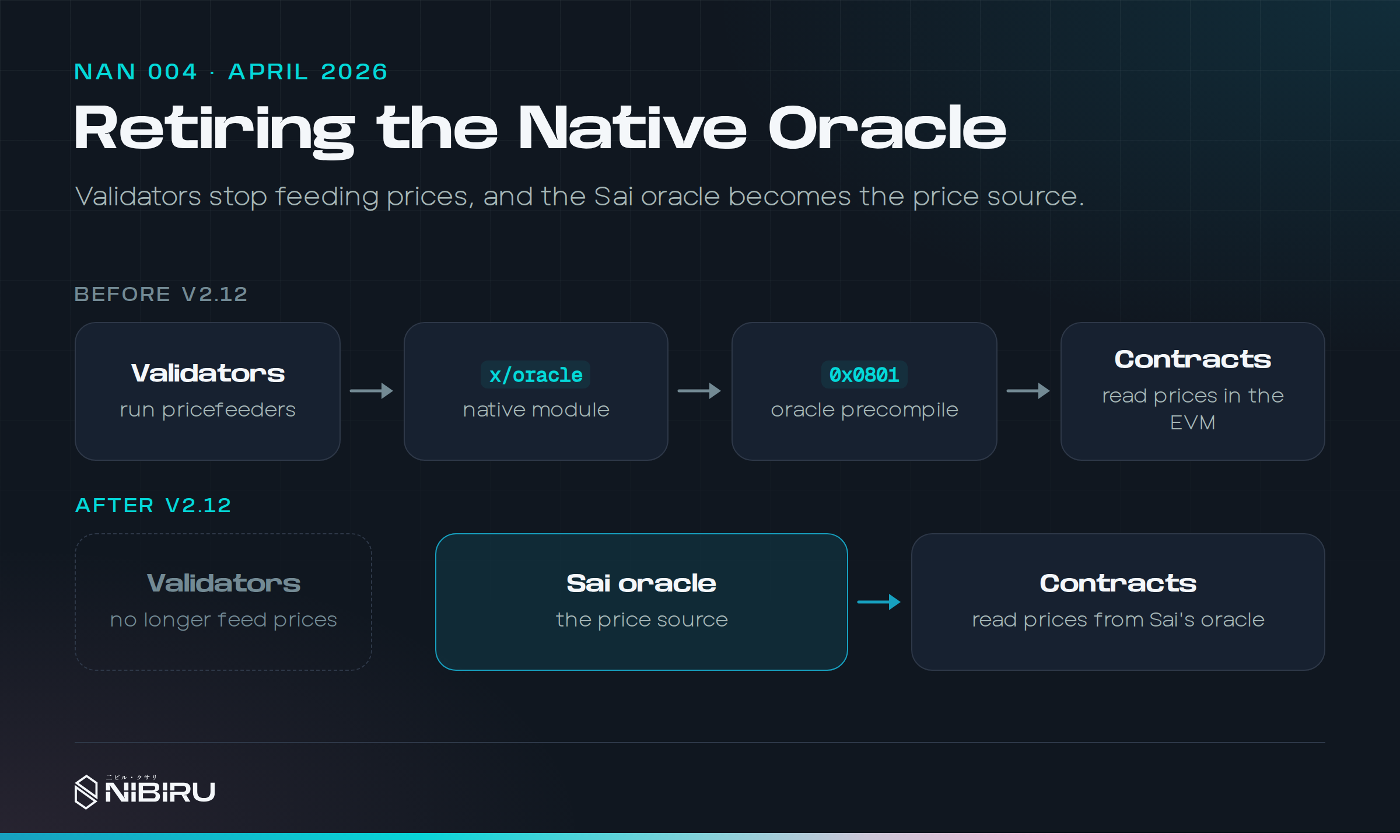
Nibiru launched with an oracle built into the chain. Validators ran a pricefeeder alongside their node, voted on exchange rates each period, and got slashed if they missed too many votes. Contracts read the result through the x/oracle module or, on the EVM side, through a precompile at 0x0801.
On paper, that's the decentralized way to do prices. In practice, most of the benefit never showed up. Every validator ran the same pricefeeder software, so many voters running one program added little over a single good feed. The costs, meanwhile, were real:
- Validators could be slashed for running the correct software. When a market moved fast, honest votes could land outside the module's tolerance for deviation, and the validator got penalized anyway. This happened more than once.
- Changes were slow. Adding a market or changing how a price was computed meant a chain upgrade.
- It was code we had to maintain in the most sensitive part of the chain, for prices our main product didn't read.
Sai already ran its own oracle as a smart contract, and it was better on every axis we cared about. It covers stocks, ETFs, commodities, and far more crypto assets than the native oracle ever did. It updates more often. We can change it with a contract migration instead of a network upgrade, and we iterated on it quickly all year.
So the question wasn't whether the native oracle was decentralized. It was whether keeping it made Nibiru more likely to win. We'd written that code, but having written it isn't a reason to keep it. It was tech debt, and removing it meant less code, fewer places for bugs, and no validator slashed for doing its job.
v2.12.0 makes the module inert (PR #2547):
- Oracle transactions return a deprecation error right away.
- The upgrade handler clears the whitelist, votes, miss counters, prices, and snapshots, so nothing stale stays queryable.
- The upgrade removes slashing, the end-block hooks, the CLI, the Wasm query route, and the EVM precompile.
- Query routes stay registered. They return empty results, so callers that expect the endpoint to exist don't break.
We left the module in place, inert, on purpose. This is a soft deprecation. Deleting the module outright changes the store layout, and we didn't want to risk a mainnet outage for no clear gain. An inert module adds little to the binary. It gets validators out of the price business now and keeps the upgrade simple.
We'd still like to remove the module completely someday, and to learn how to delete a module's state safely along the way. Until that's clearly safe, soft deprecation is the pragmatic choice.
What we got wrong
Removing the precompile broke a caller we didn't account for. MIM's OFT bridge quoted its fees through 0x0801, and those quotes started reverting. We brought back a narrow version of the precompile two months later, backed by Sai's oracle instead of the old module. NAN 005 tells that part.
The lesson I'd take from it: before removing a contract-facing address, find every deployed contract that calls it, not only the ones you maintain.
2) FunToken creation needs authority on mainnet
A FunToken maps a Bank coin to an ERC20 contract so the same asset moves between Nibiru's Cosmos and EVM sides. Until v2.12, anyone could create one on mainnet. Now it takes governance or the chain's sudo admin (PR #2548).
Testnet and local networks keep permissionless creation, so builders can still experiment there. On mainnet, someone reviews a mapping before it becomes canonical.
The release also hardens how precompiles authorize calls.
3) Failed EVM transactions stop leaking events
When an EVM transaction fails, the EVM rolls back its state. Nibiru's Cosmos side could still emit events from work done during that transaction, such as a Bank transfer. An indexer reading those events would record a transfer that never happened.
v2.12 truncates those leaked events while keeping the EVM's own failure record intact (PR #2543). It was the first of two fixes in this area. v2.17 went further and rolls events back with every EVM snapshot. NAN 006 covers that.
4) Faster tests
After the release we spent a few days on the test suite. Integration tests now run against a persistent localnet instead of starting a chain per test (PR #2550). A change to the coverage mode cut Go test time by more than half (PR #2560). Two more fixes removed sources of flaky results (PR #2559, PR #2562).
Users never see this, but it sets how fast we can ship everything else.
One small CLI change for builders: nibid keys list now shows EVM addresses too (PR #2549).
5) On Sai: stocks, ETFs, and commodities
April was Sai's biggest listing month. 21 of the 25 symbols we scoped went live across stocks, ETFs, and commodities. We wrote about the launch in Sai Launches Stock Trading on Perps.
The app picked up a few things to go with it:
- Starred markets, with your open positions pinned at the top of the market list.
- A price-impact chart for each market, so you see the cost before you trade.
- Your positions drawn on the TradingView chart.
- Install Sai as a desktop app through PWA support.
All of these markets run on Sai's oracle contract, the same one that replaced the native oracle above. Since late 2025, the contract has emitted one combined event for each batch of prices it receives, so indexers can read a whole update in a single pass.
What's next
The oracle removal left loose ends. Some docs and tooling still referred to pricefeeders, and one bridge still needed 0x0801. We spent May rehearsing the fixes on testnet, and v2.14 and v2.15 shipped them in June.
References
Pull requests behind each section. The Sai repositories are private, so the text above describes each change on its own.
1) Why we turned off the native oracle
- nibiru#2547: Retire the native oracle in the v2.12 upgrade.
2) FunToken creation needs authority on mainnet
- nibiru#2548: Mainnet FunToken creation needs governance or sudo.
3) Failed EVM transactions stop leaking events
- nibiru#2543: Truncate events from failed EVM transactions.
4) Faster tests
- nibiru#2550 and nibiru#2560: Faster local and CI test runs.
- nibiru#2549: EVM addresses in
nibid keys list. - nibiru#2559 and nibiru#2562: Deterministic tests.
5) On Sai: stocks, ETFs, and commodities
- sai-web#834 and sai-web#859: The April releases with the new markets.
- sai-web#791 and sai-web#830: Price impact charts.
- sai-web#833: Your positions on the chart.
- sai-web#836: Starred markets and open positions in the market list.
- sai-web#627: Install Sai as a desktop app.
- sai-perps#255: One combined event per price batch.
- sai-keeper#325: Force-pull stock prices when the stream goes quiet.