
NAN 007: A Month Spent on Speed, and Getting Block Time Back
Posted by Unique on 2026-08-31. Prior mainnet upgrade: v2.17.0.
Summary
- We spent August on speed. Engineering's one priority was making trading on Sai feel instant. Mobile waited.
- Sai loads fast on return visits, and your trade shows up the moment you click.
- Mainnet blocks are back to about 1.5 seconds, down from 2.66 in July. The fix was getting validators to propose blocks on time, not changing the chain.
- Referral earnings follow the referral code, not the wallet that owns it.
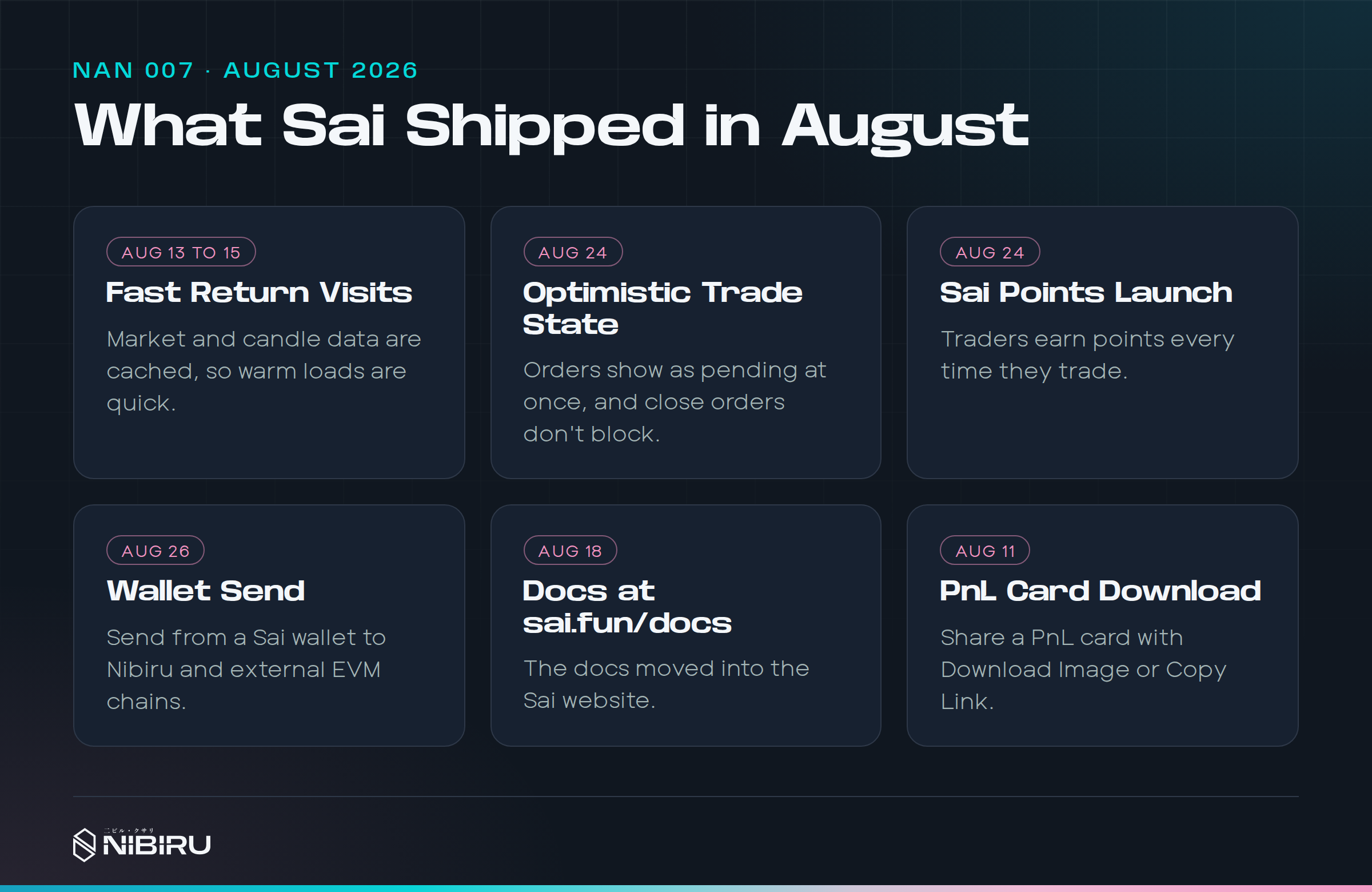
- Sai Points launched on August 24, and Sai's docs moved to sai.fun/docs.
1) A month with one priority
We talk to a lot of Sai traders. When we sort what they ask for, well over 90% of it comes back to one thing: speed. How long a trade takes to go through after you click. How long before it shows up in your positions table. Whether moving between screens feels sluggish. Feature requests and bug reports come in too, but they're a small share next to that.
Plenty of traders already like Sai. Making it fast is how we make it better for nearly all of them at once. Talking to users is how you find the one problem worth focusing on, and this was it.
So in August, engineering worked on one thing, performance and smoothness. Mobile and the native app waited.
The clearest example of the problem came on July 31, when a trader clicked to open a position and ended up with two. The app didn't know whether the first trade had gone through, so it let them try again. That double-open showed us the real problem. When you trade, three separate things happen:
sent       -> your wallet broadcast the transaction
included   -> a block on Nibiru contains it
indexed    -> the Sai Trading Engine has recorded it and the app can show it
The app had treated those as one moment. It waited for all three before it showed anything, and it didn't remember that a trade was in flight. August's work separated them:
- No double submits. A trade in flight locks its button until the app knows what happened.
- Optimistic trade state. Your order shows as pending the moment you click. A close shows "Closing…" until it's done, even across a refresh.
- Cached market and candle data. A return visit renders from cache first, then catches up. Live data still wins when it arrives.
The chart also gained volume and fill arrows, so you can see where you got in and out.
This was also the month we started recording intents. An intent is a record of each action a trader asked for, from request to result. Intents are what made one-click trading possible in October.
A lot of the slowness turned out to be the app's own data plumbing, not the chain. In August we stopped it from fighting itself:
- Healthy connections stay up. The app was tearing down a working GraphQL socket at startup, and a quiet price stream reset every subscription about every 40 seconds, which made prices flicker.
- Prices show before the socket connects. On a cold start the app shows the last known prices, then fetches fresh ones over HTTP. In our measurements HTTP returned every price in about 240 ms, about half a second before the first WebSocket frame.
- Pending trades survive a reload. The record of a trade in flight lives in IndexedDB now, not in memory.
August was the start, not the whole job. The same focus carried through September and October. If we'd kept picking up unrelated tickets, the core problem would have improved so slowly that it might as well not have improved at all.
Switching markets went from 1.1 to 1.8 seconds down to about 0.1, mostly because the app stopped waiting on an analytics call. After a trade, Sai now reads your balance straight from the chain in about a tenth of a second, instead of waiting for the Sai Trading Engine to index it. On mainnet that read took 72 ms at the median across 117 reads, with no mismatches. Switching between the Positions, Orders, and History tables is now instant, because each table keeps its rows and shows them while it refreshes.
The slowest step left is the wallet. MetaMask checks for a receipt every four seconds, so a trade can sit finished on chain for a couple of seconds before the app hears about it. That's next.
2) Getting block time back
Sai can only feel as fast as the chain under it. In early July, mainnet averaged 2.66 seconds per block. A healthy Nibiru block takes about 1.5.
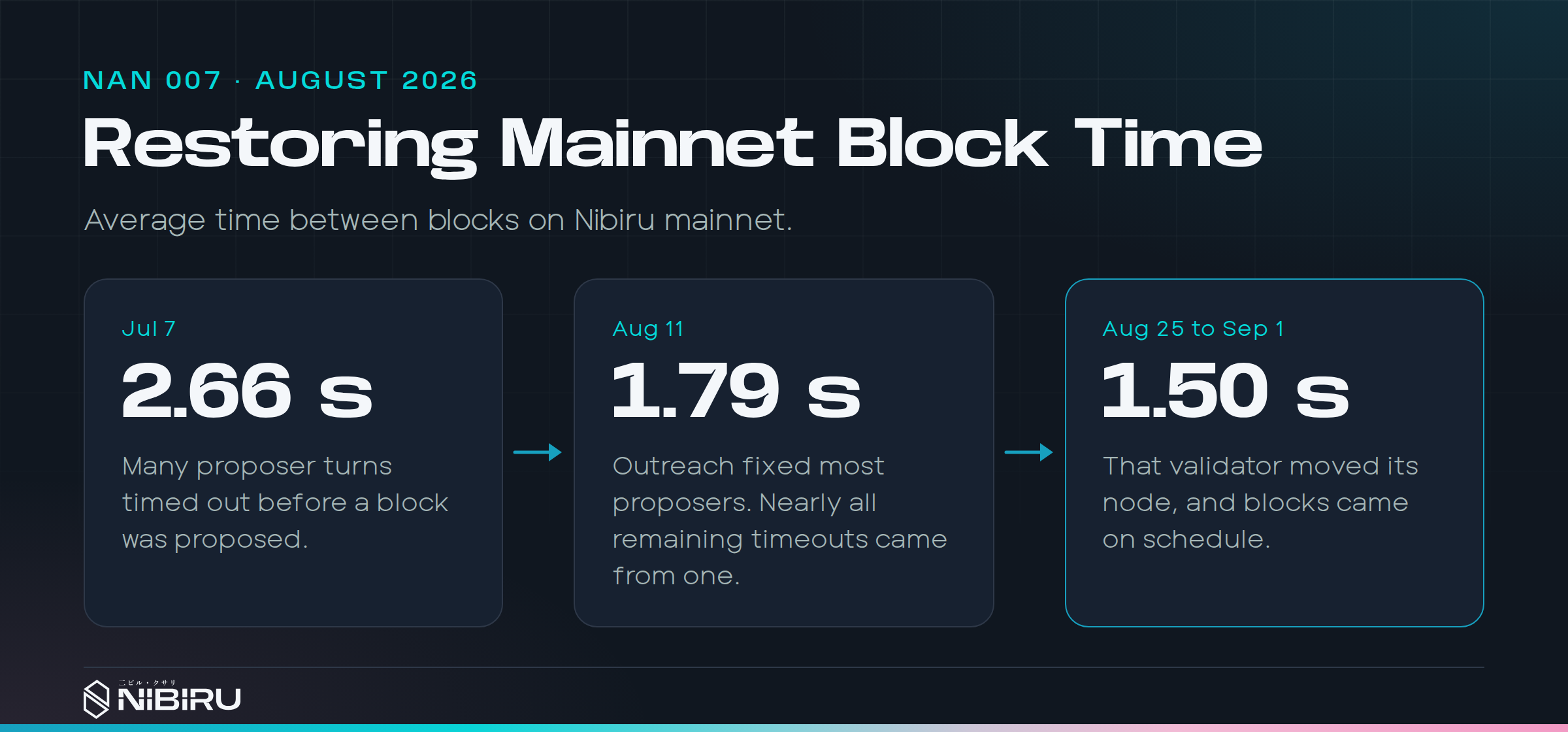
We didn't guess at the cause. We matched our validator's consensus logs against which validator was scheduled to propose each block. The slow blocks weren't slow to execute. The scheduled proposer never sent a block in time, so the network waited out a 3-second timeout and moved on to the next round.
That made it an operations problem, not a code problem. We reached out to the validators whose turns kept timing out. After the first round of fixes, the daily average fell to 1.79 seconds by August 11. The remaining timeouts came almost entirely from one validator's turns. That validator moved its node on August 24, and from August 25 to September 1 mainnet averaged 1.50 seconds per block.
We didn't change Nibiru to get here. We got the network back to working the way it already should. We turned the investigation into a runbook, so the next time block time slips we can find the cause without starting over.
3) Gas estimates you can trust
Before a wallet sends an EVM transaction, it calls eth_estimateGas to decide how much gas to attach. Nibiru's estimate doesn't guess. Two chain changes make it accurate.
The first is about precompiles. Ethereum's precompiles charge a fixed cost based on the size of their input. Many of Nibiru's don't work that way. A call into the Wasm precompile runs contract logic, and the bank and FunToken precompiles move real balances, so the cost depends on what the call does. Nibiru's precompiles now report dynamic gas, metered by the same Cosmos SDK gas meter as everything else (PR #2516). The EVM sees what each precompile call really used.
The second is the search. The estimator first simulates the transaction at the highest allowed gas limit, and uses the gas that run consumed as its lower bound. Then it binary-searches upward to the smallest limit that succeeds (PR #2424). Simulating first keeps the search short.
Run a simulation against Sai's contracts today and the estimate matches what the transaction uses.
In August a Sai trader hit an edge case. A valid close ran out of gas inside a precompile's token transfer, and estimates for the same close jumped between two values about 505,000 gas apart. Sai's transactions run at zero gas price, so an oversized limit costs the trader nothing. Sai now doubles its estimates, with a floor of 2.5 million gas, instead of adding 10%, and the app no longer reports out-of-gas deposits as successful.
4) Referral earnings follow the code
Referral earnings on Sai attach to a referral code, and a code can change owners. The old indexer inferred referral earnings from wallet history and from the code recorded when a trade opened. That breaks when a code changes hands, or when a long-lived trade's active code changes. Now the code is the identity. Volume and revenue belong to the code that was active when they happened, and a new owner inherits the code without rewriting its history.
Every referral event from the contract now carries both the change and the running total. If the Sai Trading Engine misses an event or replays a range, the next total puts it back on the right number.
5) Sai Points, and docs in one place
Sai Points launched on August 24. Traders earned points for trading volume and weekly streaks through Season 1, which ran until October 4. The launch post has the rules, and the Season 1 rewards post covers how rewards were decided.
Points launching in a month we'd set aside for speed isn't a contradiction. Engineering focused on performance, while marketing and business development ran Points in parallel. Neither took anything from the other.
The same day, we stopped paying for Gitbook. Sai's documentation now lives at sai.fun/docs, next to the app. The site, the docs, and the app now share one domain and one codebase, so a link from a trading screen to the page that explains it stays inside Sai.
6) Also on Sai in August
- Wallet Send lets you send from your Sai wallet to Nibiru and other EVM chains.
- PnL cards download as an image or share as a link.
- Fee tiers now count dollar volume.
- Direct USDC withdrawals, with bridging and withdrawing as separate steps.
- A 1% maximum slippage on opens.
- A feedback form inside the app.
References
Pull requests behind each section. The Sai repositories are private, so the text above describes each change on its own.
1) A month with one priority
- sai-web#1098: Prevent duplicate trade submissions.
- sai-web#1184: Optimistic trade state, pending display, and non-blocking closes.
- sai-web#1110: Reconcile position closes durably.
- sai-web#1094: Loading skeletons.
- sai-web#1147: Cache market and candle data for warm loads.
- sai-web#1172: Trading intents, reported through the Sai Trading Engine.
- sai-web#1170: IndexedDB outbox for pending trades.
- sai-web#1155 and sai-web#1157: Stop restarting quiet subscriptions and tearing down the socket at startup.
- sai-web#1177 and sai-web#1178: Load market data and prices over HTTP first, with the HTTP and WebSocket timings.
- sai-web#1199: Reuse RPC queriers across subscription updates.
- sai-web#1112: Fresh balances after a trade.
- sai-web#1232: Market switching from 1.1 to 1.8 seconds down to about 0.1.
- sai-web#1256, sai-web#1258, and sai-web#1299: Read balances from the chain right after a trade, and keep them consistent until the Sai Trading Engine catches up.
- sai-web#1294: Trading tables that keep their rows while they refresh.
- sai-web#1328 and sai-web#1337: Cut repeated RPC reads, and reconnect the block socket once.
3) Gas estimates you can trust
- nibiru#2516: Dynamic precompile gas, metered by the SDK gas meter.
- nibiru#2424: Simulate first, then binary-search the gas limit.
- sai-web#1131: Pad Sai gas limits against unstable precompile estimates.
4) Referral earnings follow the code
- sai-perps#363: Key referral fees by code.
- sai-perps#395: Lifetime referral totals in every referral event.
- sai-keeper#491: Apply referral events idempotently and track code ownership changes.
5) Sai Points, and docs in one place
- sai-web#1191: Launch Sai Points.
- sai-web#1185: Build Sai's docs into the website.
6) Also on Sai in August
- sai-web#958: Wallet Send.